“The morning shadows are long and the waterfront park is slowly filling with locals, chatting over Turkish coffee and beginning their day with the casual, comfortable chatter in a style that only years of hunching over a chessboard or backgammon board in mortal combat with close friends can bring.
“I am exhausted. It has been an impossibly long night of love making. Spring has brought out orgiastic behaviours. Multiple partners, and the unabashed screams born of lust drowns out the complaints until at last, there is nothing to do but collapse in exhaustion.
“The dogs of Sukhumi are having far more fun than I am.”
Max asked me what I was always writing in my notebook and I showed him this page. He frowned until the last sentence and then grinned wryly.
The flight to Sochi was uneventful, other than I could speak English with nobody. The regional airline, S7 gave a clean flight, on time, and pleasantly. The big difference to me was in the airline food. Airline food is airline food everywhere. It is mass produced and designed to be delivered to an audience that already knows that airline food is stuffer, not to be enjoyed, Any complaints about airline food bring two responses: “Join the long line”, or “what’s the use?” However, in this part of the world, while still airline food, is a different collection of airline foods and I enjoyed the new flavours. The fact that I couldn’t understand the labels helped immensely.
Still, arriving at the Sochi airport was a treat. It was like arriving in Florida, with a blast of welcome humidity and warmth that let me know that this wasn’t Moscow any longer. The pace had slowed and the sheer size of every is more appropriate for a town of 400,000.
Sochi is important to the world for a number of reasons.
For decades it has been the Palm Beach of Russia, with expensive dachas lining the Black Sea Coast and fabulous resorts like Dagomeys. Lenin had his favourite Dacha in Sochi as did many of Russia’s leaders.
More recently, Putin has placed about $11 billion in investment into Sochi to create a sun and ski tourism infrastructure. Russian tourists were taking almost $2 billion each year out of Russia to go ski and vacation in Europe and Putin wanted to stop the flow of hard currency out of Russia by providing an alternative.
Putin also wanted to ensure that his legacy-to-be, the 2014 Winter Olympics, would be in Sochi. When Sochi was awarded the Olympics, Russia began to pump another $11 billion into the area to bring the infrastructure up to Olympic standards.
Sochi is also 12 miles from the Abkhazian border. The last thing Russia needs is Georgian tanks 12 miles from their Olympic site, and there are many reasons why Abkhazia is what it is, but as a poor and fairly powerless state, Abkhazia provides a convenient 200 km buffer between Georgia and Russia and Russia likes this.
In May 2008 Georgian tanks were massed on Abkhazia’s southern border. The United Nations observers (UNOMIG) are nice fellows who take long walks through the mine laden woods looking for such things. They noticed the buildup and let their chain of command know. French President Sarkozy made a trip to Moscow, then Tblisi, Georgia’s capital and diffused the situation with diplomacy for a short while.
The UN takes a bad rap for its public failures, so it was gratifying to see that circumstances often prevent the UN from receiving praise when they deserve it.
Georgia was also sending unarmed drones over Abkhazia and the Russian air force was knocking them down regularly. These Israeli drones cost about $1 million each and probably were part of a garage sale of unused and soon to be obsolete equipment.
I had not met my friend Max until he picked me up at the airport in Sochi. Maxim Gunjia is well described in one article a few years before as a “hip, 28 and into restaurants, art and jazz. He is also the deputy foreign minister of a country that no legitimate government recognizes…” This, I thought was the antithesis of what to expect from old Soviet leadership but Max fits this perfectly. He once rebuked me (for negotiating over a small purchase) with, “That’s just not cool”, and I understood completely.
After a year and a half of chatting on the phone, and emails, it was good to meet him in person, but I was again distracted by all the sensory input of a strange land. The road from Adler to the border winds along the Black Sea and Max dutifully alternates between pointing out landmarks and chatting in Russian to his friends who he had also picked up at the airport.
The quiet man driving dropped us off at the Psou border crossing and we walked our luggage into Abkhazia, through the customs and nobody seemed interested in checking my luggage. I’m not sure how I would have explained the 19 bottles of Icewine hidden in the suitcase that were leftover from wine tastings and sales calls in Moscow.
The journey out of Abkhazia a week later was also a treat, and I’ll share some stories during that week in future posts.
I left Abkhazia by taxi. The taxi was arranged by friends, and the taxi driver was an affable chain smoker who spoke no English. I could now speak about 20 Russian words and I’m sure that when I did, the Russian speakers wished I would not. I asked in pantomime if I should do up my seatbelt and he motioned “no! no!”.
The main road along the coast is riddled with potholes but that isn’t a problem compared with the cows that meander along the 80 mile road north to Sochi. Abkhazia has a tradition of free range cattle. They are inured to traffic. No amount of honking will move them. Between herds of cows all drivers drive like madmen except when they come to potholes. Crossing potholes, the drivers are almost reverent. I assume spare parts for the cars are expensive.
Timing and a single word is all that one needs to make a joke between two people who don’t speak a common language. We hurtled around a corner and the driver braked suddenly and swerved skillfully. I assume he did. I was wishing for my seatbelt and the only thing I remember seeing was the ass ends of a lot of slowly moving cows. They blocked the road. The driver looked over at me and smiled, lit a cigarette and shrugged. “India” he said, and we both laughed. Eventually they moved and we got to the border.
I had no ‘juice’ crossing this border. The driver pantomimed that I should get out, take my luggage, and go through the customs line, and he would go though the fast lane and meet me on the other side.
I shuffled forward with the line until I got to the big glass window with the tiny little slit to pass my papers.
While I passed my papers, I examined the border guard. I knew that Jan Arden was performing in Canada that week but this could have been her! Under a green fore and aft cap set a round face with pretty eyes, a small attractive beauty mark on her cheek set off a pretty smile. Her dark hair bobbed at the shoulders and just missed the massive epaulets on her shoulders. Her light green uniform shirt was crisp and her skirt was knee length but short enough for me to see dark nylons and imagine uniform shoes that she could march 40 miles in.
While I was taking this in, she was opening my passport, comparing the picture to my face and looking me up on the computer.
There were five people in the booth and she was not talking with any of them as she started to sing in a quiet Russian language. I didn’t know what to make of it and simply kept smiling. She murmered her song and continued to look over the computer, my papers and occasionally looked at me.
Then her forehead furrowed. I started to sweat under my smile. She tapped on the computer and called a colleague over. They conferred in Russian and tapped some more on the computer.
You have to understand that time is relative. One persons time frame as a border guard in Southern Russia is far different than this traveler’s time frame as someone trying to cross a border in Southern Russia for the first time.
Some time later she looked up and said something in Russian to me and pushed both of her hands out towards me.
I didn’t understand. It was my turn to furrow my brow without losing the smile.
She repeated the gesture and I used one of my Russian phrases. It sounded something line “NiPanema” and it was supposed to mean “I don’t understand”. Her colleague thrust her hands out and said in English “Show hands, show hands”
Her colleague pointed at my ring finger and said “Show hands” again.
Are they asking me where my wife is? Did the computer say that I had entered Abkhazia with a wife and was leaving without one? Did they think I was a lonely westerner looking for a Russian wife? All this came to me in a nanosecond and I pointed at my ring finger, “Nye, no wife, no wife.”
Her colleague drew away and my Jann Arden sang briefly, then stamped my passport and put it down on her side of the glass. I wasn’t clear yet!
I don’t speak Russian. She didn’t speak English. However I know exactly what she said next. Her gestures towards my passport and me were very clear. I was just standing there smiling and thinking “I don’t want to go to the little room in the back” when she said with a flourish, “You take me to Canada?!”
What could I do? I took one step back from the window and one step towards (ironically) freedom in Russia and said with a big gesture and a bigger smile, “Come On! Let’s Go!” We now had the attention of everyone in the booth.
She smiled, opened my passport and wrote something inside. She passed it to me.
I opened the passport. Her name is Edita, and her cell phone number was written inside.
I knew just two words in Russian for the occasion. In a loud voice and a bigger smile, I said to her, “Spaceba Padrushka” (“Thanks Girlfriend”) and went to find my taxi. Everyone in the customs both began laughing at our brief passion play.
The taxi driver made me put my seatbelt on for the final 12 miles from the Psou River to Sochi’s airport.
Later I learned that in Russia, if you don’t wear your seatbelt, the police will pull you over looking to find lunch money.
In Abkhazia, if you do wear your seatbelt, you are clearly a tourist, and the police will pull you over looking to find lunch money.
I am not here to sell Icewine. I am here to drink in this place called Abkhazia.
It is my second day in Sukhumi, the capital of Abkhazia. There is no shiny tourist area. There are few tourists in Sukhumi, unlike the northern towns of Pitsunda and Gagra where Russian tourists still come to enjoy the beaches in dozens when before the war they came in the thousands. I am walking along a street and peeking into shops. The cars and busses that go by are all ancient and the people are tired, old, and friendly. I am peering at them and am self conscious about staring, but I’m fascinated.
In Toronto I would probably have walked right by Anna, sadly, treating her like we treat so many homeless looking folks. In Sukhumi, things are different, and I smile at everyone. Anna is sitting on a block of wood. Her clothes are old and tired and she is probably younger than the 60 years I give her. She has arranged a small flat box with bunches of cilantro and another herb I don’t recognize. Her belongings, I realize, are placed in bags on a windowsill behind her.
We make eye contact and I say hello. Everyone on this street that I have approached has spoken only Russian, or Abkhazian, or perhaps other languages, but certainly no English. I expected that the world would understand a simple ‘hello’ in English and that Anna would nod, and perhaps smile, and I would walk on.
Her face brightens and she says, “You speak English!” I’m sure my smile got wider and and I replied, “Yes” I stuck out my hand. “My name is Phil and I’m from Canada”.
“I am Anna”
Anna’s Cilantro Shop in Sukhumi
Over the next few minutes I felt my discomfort in looking down at this affable lady who chatted so intimately dissipate. Anna, she told me studied English and Russian literature in university in Moscow and then taught it for some years, “but look at me now!” A lady walked by between us and stopped to ask about the cilantro. They exchanged a few words and the lady abruptly walked off. Anna surprised me with, “I don’t like those people”. Then her English deteriorated as the emotion rose in her voice. I think that she told me that “those people come down here and move around like they own the place.”
“They produce nothing, and contribute nothing. They are terrible.” I wanted to continue talking with her but that initial connection was broken by her emotional explanation. I wanted to ask her if I could buy her coffee, or lunch and learn from her, but I also feared that it would be taken as charity and I might become one of ‘those people’ in her next story. I also wanted to take her picture but I felt that I had already delved into her private life enough. The picture was not important.
About a half hour later I came back and the block of wood was sitting empty on the sidewalk and Anna’s bags were still on the window sill, but Anna was gone.
Abkhazia is a difficult place to write about, but I have to describe Abkhazia before I can write about some of the adventures and people I met down there and how it connects to Icewine. Context is so much more important.
Abkhazia
Abkhazia is a land sandwiched between Russia and Georgia on the north and south, and the Black Sea and the Caucasus Mountains to the east and west.
My innocuous description of where Abkhazia is located is enough to start a fight in many parts of Russia and Georgia. I used the word ‘land’. It would cause dispute to call Abkhazia a country, or in some circles to not call it a country.
As of today, only four countries recognize Abkhazia as a country so that term is in dispute. The Georgian interests claim that Abkhazia is a part of Georgia that broke away in a bloody conflict in 1991 and is held by rebels. Only the 3000 or so Russian peacekeeping troops standing on the southern border for the last 18 years have kept Georgia from physically reclaiming the territory. Georgians would argue that Abkhazia is not bordered by Georgia in the south, but is rather a province in northern Georgia. Similar arguments are made around South Ossetia, where the bulk of the 2008 Georgian-Russian war was fought.
After the 1991 war over 200,000 ethnic Georgians fled Abkhazia, leaving approximately 80,000 ethnic Abkhazians in control. Since then, Abkhazia has been blockaded by politics, economics, and geography. Abkhazia’s only significant trading partners are Russia which maintained a leaky border on the north, and Turkey, who has some mining interests and can ship across the Black Sea.
There are many gorillas in the room but the biggest one seems to be about the displaced Georgians. How does a democratic country of perhaps 80,000 people repatriate 200,000 people and not lose effective control of their country? How do they address the repatriation of the assets that the Georgians lost when they were forced to flee? What is ‘right’?
It is not an uncommon problem. The Soviet Union and Imperial Russia has had a long tradition of relocating large numbers of people, often in the middle of the night and usually at gunpoint, and there have been many such relocations in the region.
The news media distorts our North American view of Abkhazia. America sides with Georgia which sets up little Abkhazia and South Ossetia smack in the middle of the supposedly dead cold war. Over the last few years, various American news agencies have described Akbhazia as a muslim hotbed of terrorism. In fact, over 80% of the people in Akbhazia are Orthodox Christians. I am sure that distortions happen on the Russian side as well, but I don’t read Russian so I can’t point at it.
Ultimately, I believe that who is ‘right’ depends on how far you want to go back to establish those rights, which effectively means that to outsiders like me, there is no ‘right’. There sure have been a lot of wrongs!
So what remains are shadows of the past: Dark memories and confusions and impossible loyalties to lands where one grew up but cannot live and loyalties to lands where one lives under constant threat. The world only knows the simplest of these stories as told in media headlines and sound bites.
The first thing you notice when you meet people from the Caucasus is that they are incredibly hospitable. They may be Circassian, Abkhazian, or Georgian or a hundred other ethnicities in the area and perhaps not get along so well, but once they recognize you as a guest, you can relax and enjoy discovering your hosts and delight in the history, culture and friendship.
I wanted to describe Abkhazia in fairly objective terms. It will form a framework for all of the anecdotes and tales that come from my visits in and around Abkhazia.
I loved the land and the people, both in Akbhazia and those I met who were displaced. If you can look beyond the bullet holes in the walls, or peer back through time to see the glorious parks and architecture or stroll around and meet people, it makes it easier to ignore the ‘gorillas in the corner’ that over time will have to be addressed or once more fought over.
The food is the freshest I have ever enjoyed. The water runs pure from the mountains. If ever a land deserved peace and reconciliation, Abkhazia does.
The confusion continues. Little things like two golden arches under “Макдоналдс” give me an anchor that lets me know that not every symbol is foreign. I can’t help thinking that this might be how a stroke victim would feel if they lost their ability to read and hear cognitively, but kept all of their other faculties. I suppose that the difference is that I am sure that I could regain my connection with this Earth with study, practice and time, but a stroke victim would not be sure that is the case. If my analogy is correct, I have so much more empathy for stroke victims now.
For some reason my brain has shut down on some of my math functions. While I have no trouble doing math with a pencil and paper, or doing other math exercises that I know that I can do, I am absolutely baffled by the ruble-dollar conversion formula. I have a few thousand rubles, and everything is significant has gone onto a credit card, so I’ve had to deal with local currency in local currency. Try as I may, under the waiting watchful eye of the shopkeepers and with a line of impatient Russians behind me, this Canadian simply shuts down when it comes to understanding how much whatever I am buying is costing in Canadian dollars. I dutifully hand over the amount of rubles. It is a lot easier to hand over bills with big numbers on both sides than it is to count out change, so I have a growing pocket full of Russian coins. I also am stoic. It costs what it costs and if I want it, I pay it. I don’t have the language to negotiate and the stuff that I am buying is really non-negotiable. But it still irks me not to be able to do a simple calculation.
Moscow is a city of contrasts and contradictions. The contrasts are sometimes with each other and sometimes with my North American frame of reference. Mostly these contrasts are simply interesting, but however interesting, these contrasts add to the cacophony. I finally figure out the exchange formula. It is rather easy. 23.6 rubles is one US dollar. In seconds you will figure out a fast way to do the conversion in your head, but it has taken me three days. Call it 25 rubles per dollar. Then assume 100 rubles is 4 dollars. Go from there. It did me no good to do it more correctly or by the easiest method because I either went backwards or put the decimal in the wrong place. Again, frames of reference are confounding me. A coffee is 150 rubles, or about 6 dollars. An 11% beer, which is excellent and served from the coca cola and other street meat stands, is just 40 rubles, or what, a buck and a half for a half liter? Gasoline is about $1.00 per liter and a pack of cigarettes are over $10. The first night here, I spent 300 rubles on two coffees and felt bad that I had spent $16 on a couple of coffees. My friend didn’t understand what I meant but now I realize that the coffees were only $12 dollars, close enough to the Starbucks price points to apply the standard reasoning “This is Moscow” to put things in perspective. Besides, it doesn’t really matter. The price is what it is.
While my friend from Russia immigrated to Canada and in about a year or so learned English from North American television shows like Friends and Seinfeld, I am only here in Moscow for a short while and therefore surf endlessly through the sixteen channels looking for some signs of familiarity. Mel Gibson and Julia Roberts are now discovering plots within plots in a dubbed version of the movie Conspiracy. If I listen really carefully, I can hear the subdued English dialog and it helps. Yesterday I chanced on a show that seemed to be based on the Quebec show ‘Surprise Surprise’. It consisted of skits where stunningly attractive women would ambush men with sudden nudity and the hilarity ensued in front of a hidden camera. It contained no dialogue and may not have been a Russian show, but I saw it here first and was confounded by the inanity of it. But showed wonderful breasts, and was a half hour of distraction.
I celebrate the coffee houses that put pictures on their menus. That is what I choose. I point to it and hold up a single finger and smile and say please. I could say spacebo but I feel that would be just too fraudulent and so I smile and point. This morning I pointed to a quiche-like picture and was asked, thank God, if I wanted a chicken or fish. I don’t think I could face a Russian fish quiche with coffee first thing in the morning.
Street Meat, oh the choices!
The street meat is varied and excellent. The stands are large semi-permanent wagons with a small window about 15 by 30 centimeters through which one talks and exchanges food for money. The fronts of the stands are Plexiglas and display the wares in a chaos of packaged food, fresh food, and beverage labels. There is a starch wagon (stuffed potatoes, corn and panini-type sandwiches), a pastry wagon, and a Chinese food wagon, all in a row, and all with the intense security of the tiny window which protects their goods like Fort Knox. Colourful signs tell me what they sell, and I can see pastry shrouds with meat like substances peeking out of the ends, in some cases. Overhead the panini store shows pictures of panini sandwiches laden with rich fillings. I realize I could cause serious damage to the shopgirl’s neck by pointing and asking for ‘one of those up there, please’ so I wait in line. With nobody behind me to watch my clumsiness, I point to what the last guy has ordered and say, “same please”. It works. For about three dollars, I get a big beer and a double baked potato with Russian ‘stuffings’. It is among the best street meals I’ve ever had. For all the security of the wagons, the beer is kept in coolers with large unsecured doors beside the wagons and people pay, and then serve themselves under a watchful honour system. Another contradiction, I think.
On the way back, I stop at the pastry hut and point to two of the meat filled pastries. One ends up being a sausage affair wrapped in a tortilla like dough wrapper, and the other is chicken in a bun, but done oddly. “It is what it is and This Is Moscow”, I think as I cart my treasures back to the room to write notes and channel surf for precocious and daring practical jokers with lovely breasts. The Russian morning TV shows contain two things I understand: the exchange rate to US dollars, and the little weather symbols; sun, rain, clouds, and such that let me know whether the umbrella I carry always will be useful.
Almost six months ago my son left the umbrella in my car and when I mentioned it over the phone, he just said, “that’s all right dad, I’ll get it later.” I wonder if he’ll appreciate that his umbrella went to London where it was never rained on, back to Canada, then over to Amsterdam and on to Russia, where it was a most welcome shield against the metaphoric and wet rain on Moscow.
I had dinner last night at a fabulous new restaurant with two American ex-patriots and a most charming local lady who was a marketing manager for Vogue Russia. The restaurant had a relationship with Baccarat crystal and the second floor place was a Greek revival stage crowned with crystal over deco seating.
A consummate bon vivant, our host charmed the sommelier with a bottle of Canadian Icewine, which is virtually unavailable in Moscow and chatter and smiles, and we four were seated by the kitchen at a most wonderful table meant for twelve. “There is a three month waiting list for this place, he said gleefully”. But the floor and walls are simply vessels for two things. The crystal chandeliers are huge, expensive, and require Ionian columns to keep them visually aloft. Over the evening, I discover from the sommelier, our host, the waiter, and eventually the chef, the price of the larger chandeliers.
“That one is six hundred and fifty thousand.” and then pausing for dramatic effect continued with, “Euros”. Later, “that one is four hundred thousand”, pause, “Euros”. It was not the time to tell anyone how challenged I was with currency conversion. The chef, David, is a hot Moscow chef from Alsace. He visits the table and either offers, or we draw from him, the most prized of prized meals, “something off the menu”, which is usually the best of the best from a chef. After four appetizers and two bottles of amazing wines, we are not sure whether the main course has come and gone or is yet to come. The chef is preparing minimalist food and the portions are aggressively small. The soups are amazing. Excellent melon soup served in an espresso cup and with a tiny sugar spoon creates a discussion about what kind of slice of meat that is the size of a quarter is floating in the soup. Is it proscuitto or, and I forget the obscure and elite regional hams mentioned? When the chef arrived at the table and disclosed that distinct ingredient, there is a big group ah-ha and smiles all the way around.
Next, crab flakes were adorned with the Moscow fad of the moment, foam. It was important at the time to know where the crabs came from, and launched a discussion about the qualities of crabmeats from the crab regions. I didn’t think that the top hook in the packaged meat department at ValuMart qualified as a crab region, so I didn’t contribute much to the conversation.
To make the foam, cucumber juice is gasified and shot out of a seltzer bottle into a foamy fiction. It is an interesting technique and chefs across Moscow are furiously perfecting their foam dishes to join the fad. If you manage to get it to your mouth on a fork, it vanishes, leaving the scarcest hint of cucumber on your palate. It is perfect for a nouveau foofoo fad, but one craves a steak afterwards.
Our host orders a Shiraz red wine. It was simply amazing. But where is the main course? Out comes the lamb. It consisted of two baby lamb ribs and a couple of rolled pieces of loin about the thickness and size of two Ritz crackers on a beautifully painted plate, which in turn sat on a on a Limoges charger (€700 each we are told!). It was excellent, but that fabulous bottle of Shiraz far outlasted the main course, and I was thinking that I should be able to buy a couple of entire lambs for €700. More courses, but the theme seemed to be tiny exotic tastes with many exotic ingredients and served with a confusion of sauce. I mentioned the soups were excellent and poopooed the foofoo foam. However, the chef served a warm foamy soup in another espresso cup that hinted of tarragon. When the chef came to visit as he often did between courses, he advised us that it was escargot soup. It was not really escargot, but sea snails, turned into a white foam and presented with tiny little itsy bitsy rye bread squares. It was a delight, and a further delight discovering what it was after we had enjoyed it. Desert was built for us and was the biggest course of the evening. A sauterne complimented the dessert. Our host picked up the check and prevented me from the agonies of translating rubles into dollars and for that I was truly grateful. As I walk away from that episode, I realize another bucket of Moscow contradictions. I loved the place, the chef, the wines, and the sommelier. There are bright points in the selections of foods. The style of cuisine confused me. But it is the hottest restaurant in town for now, until someone outfoams the foamers.
Among the courses were stories about restaurateurs, Moscow entrepreneurship, the experienced expatriate view, and the Vogue ingénue’s native vision which all had a calming effect on my Moscow-shocked psyche. The same company anywhere would have been a consummate treat for me, but as we sat absurdly in leather chairs beside the open kitchen and at a massive crystal trimmed banquet table adorned with antique lace and in the deepest of Greek revival architecture and further, in the bourgeois center of the Empire that inspired the Klingons, all of the Moscow cacophony was reduced to a whisper compared to the lively and organized chatter of the other three people at the table.
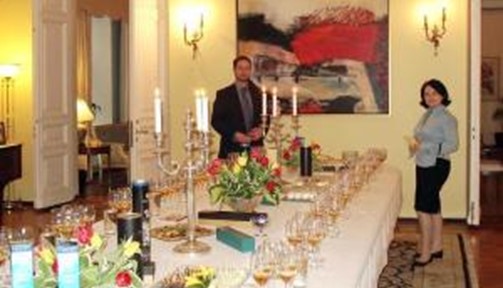
I could type a whole lot of stuff about this event. The Canadian Ambassador,
Embassy Icewine Tasting in Moscow
Ralph Lysysyn, was kind enough to open his doors to allow me to co-host the tasting in the private quarters of the Canadian Embassy. 55 of Moscow’s top wine enthusiasts left the tasting as relative experts in Canadian Icewine.
The high point for me was getting to know many of them during and afterwards, and I’ve enjoyed keeping contact with many of them over the past year.
One of the finest local magazines in the world, Passport Magazine, is an English language magazine that covers Moscow. It is a great read and brings Moscow culture and history alive for us Anglophiles who would otherwise not be able to read Russian.
I wasn’t prepared for the fatigue that set in in the short subway ride back to
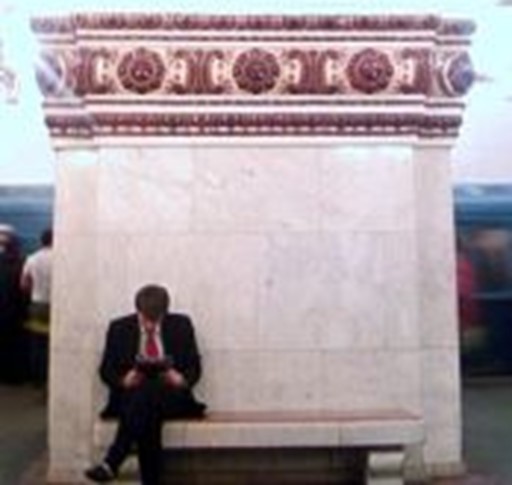
Moscow Subways are Simply Spectacular
the apartment near Victory Park. Every symbol on every sigh is cryptic and the noise of the Cyrillic characters drowns out the English words, which if noticed, simply tease with partial information. They are another puzzle masquerading as a solution to me. “Number 2 line, one stop, Ring line, one stop, red line, one stop, down Gagarin street, turn right , go to number 3.”
The subway is rushed. Russian politeness means taking the next place in line. Yield means nothing, and when a train disgorges its rushing hordes, I have to stop my puzzle solving, duck into an alcove, and try to reconnect with whichever side of my brain I use for puzzle solving. It is a fair distance from the side that runs from the subway’s rushing hordes. The pun fits so well today.
The subways are decorated in what I think of as traditional Soviet art; mosaics and portraits of serious workers, sometimes taking time out to release a white dove, and under the watchful eye of Lenin at the place of prominence at the end of the platform.
In the last three weeks I have been in four world class capitals. I returned to London after a 42 year absence. London is a noisy city and a very dangerous one. While riding in the famous London cabs, I realize that the white lines in the road are simply suggestions. In five days in London, I don’t get the hang of massive traffic on the wrong side of the road. I almost join generations of road kill twice before I hear a father say to his eight year old son, “OK, follow the green man” referring to the pedestrian walk light. I was last in London as an eight year old and perhaps this is a coincidence, but I took the advice in London and remembered it in Moscow where white lines on the road are not even vague suggestions, but challenges to drivers to find, and hold, a place in the road.
I was standing in Trafalgar Square trying to remember an eight year old standing there 42 years ago. “Where did I stand?” “Did I climb on the lions?” “Where did all those aggressive pigeons go?” I could not connect across the years but I knew that I should have been able to.
Then I walked around. I walked around the Admiralty, which sent out Cook, and Raleigh, and Vancouver and Bligh to adventures I’d read about since. I walked through the Horse Guards, who launched the massive land wars against Napoleon, and the relatively puny but successful defense of Canada in 1812. A tip of the hat as I pass Canada House, and then I am ready to salute the multicultural city that London has become. This salute starts with glass of white wine and salad at an Italian restaurant across from the Horse Guards. A further salute is found in a couple of local British ciders (“No thanks, I can get Strongbow at home”), an ice cream cone with an oddly delicious cream flavour from a street vendor, and courses of Lebanese delights in four different establishments, in the Edgeware Arab quarter on the long way home.
I had ridden the double-decker bus down Piccadilly Road, as I imagined I might have so long ago as a small boy so long ago, sitting in the very front with the huge window offering so much to see. On the high bus ride to Trafalgar, I had noticed the Hard Rock Café. I have only rare affinities for worldwide brands, but I know that the t-shirt shop solves a lot of problems when bringing home gifts for kids, and just one stop yields cool enough t-shirts from around the world. It is humbling to acknowledge some things we fear, like choosing gifts, and I am prepared to make a pact with the commercial devils to face such fears.
On the way back I’m looking down from the double-decker bus at the fences that surround Green Park and these fences suddenly erupt into a ribbon of colour. The street merchant’s cheesy enthusiasm of colour turns from flags to t-shirts to posters and starving artist art, and it was the somber stretch of old brown books that prompted me to leap up and descend from the bus.
Moldy old books! Treasures waiting for their time! I did three passes of the bookseller’s wares and each time I passed his van, within its chess board and half played chess game, I discovered he was Polish, friendly, and had hidden gems among the ratty pocketbooks: A French book of lyrics; an Arabian tale; a copy of Tom Brown’s School Days; a book of Irish tales, all well over one hundred years old, and one from 1815. They were all gifts, and each one perfect for my victims.
The prices, penciled in on the inside covers, totaled 26 pounds. I approached his van which was parked in the curb lane on Piccadilly Road. He was pushing seventy years old. He was busy chatting in Polish to two ladies and I sat in the vacant chess opponent’s chair and waited. He sat down across from me, this elderly man with so many stories not of his own. I maintained my smile and stuck out my hand, shook his, and told him, “You have the best shop in London, thank you!” He smiled and said “Thank you, but the Council wants to shut me down.” I added, “Well I appreciate your shop”. And then, “You look like you are in trouble”, gesturing to the chess board. He shrugged and said that this game would never be finished. “Would you like to play?” We had exchanged our compliments and gentle softening up of each other. I had tempted him, and he had tempted me. This was entertainment for both of us. I had to decline the chess game. I had no time; I had to be somewhere soon, I said to us both, politely and unconvincingly.
I handed him the impossibly big stack of four books. “I would like to offer you twenty pounds for your fabulous books. He smiled. He beamed. I thought, “If he thought I was Canadian he is in doubt now!” He carefully opened each cover and added the prices. “That is very low.” He smiled. “Yes, perhaps. They are wonderful books” I replied. I could let you have them for twenty three pounds. I stuck out my hand and said, “This is the best shop in London!” Our first dance over, I asked him if he had any cookbooks from the previous century. He said that he had three and we went hunting for them. He found the uninteresting one on fish, and then pulled out a general cookbook from 1885. The cover price was six pounds. The now familiar dance begins. “I would like to offer you four pounds.” And of course we are both happy to agree at five pounds.
It is a bright spot before I walk the half kilometer to the brightly lit darkness of the Hard Rock t-shirt shop.
I recall vaguely at some point in my travels on that day in London a point of incredible sadness. I watched couples walking around and sharing the monument at Trafalgar. Two young lovers spooned on the back of one of the massive lions and had made themselves alone in a crowd with each other. Other couples walked hand in hand. Groups of young teenaged girls giggled and posed for their own cameras, always with one of them not in the picture, and relegated to obscurity by some Darwinian social order that demanded that they be assigned the task of pushing the shutter. This social order was mitigated by technology and democracy where digital cameras meant that images were cheap and plentiful, and where everyone had a camera and took turns being the one left out. Then the wave of sadness hit me.
I was alone in a wonderful city with no lover to share the moments intimately with, neither at the time, or waiting at home to lovingly gush over the pictures and stories that were uncovering themselves for me on that day. A week later, in Amsterdam I did not have this happen and I was grateful to my friend and guide Anna for leading me around her city and sharing her fondness for her city. The flirting we did on the trip kept my feet and heart light, and the brief tsunami of grief that happened in London did not trouble me in the least in Amsterdam.
Pobedy (Victory) Park Monument
Now, thinking about that here in Victory Square, I wonder how I feel about that in Moscow. Victory Square is full of couples. Russian girls are impossibly thin, poised and self-important. Their boyfriends are playthings and they dote happily. The Square is a continual reminder to me of the frigid brutality of the conflict of World War II. The monuments are massive. A colossal building curves around the central monument and cups the centerpiece tower, almost tenderly. The dark angel at the top of the lofty tower is almost; well, angelic as it holds a victory wreath over the struggling brave masses of people who were sent into the grist. Many were unprepared to do much more than use up the resources of the German war machine, one bullet at a time.
The tower is busy with carved inscriptions that I cannot read, but presumably are the names of towns, many long erased, where heroes of Russia gave up their lives to stop the German war machine, and stopped the stopped the German army at the gates of Moscow. A lone rider drives an impossibly long lance into the neck of a broken dragon with swastika emblems on its side.
The long row of fountains provide a palace for skateboards and roller blades to carry their couples and their serious groups of teenaged boys and girls that are alone, but together on the wide and impossibly long parade. It seems that only I walk alone. The roofs of one massive bell tower gleam in the late afternoon sun. There is a sea of red, but ironically, it is a sea of red Coca Cola umbrellas, chairs and tables in front of the huddled masses of beverage vendors and think of the millions who died, ground up in a war for survival where so many did not survive. As I sit alone and watch all of this, I have an unkind thought that Moscow is not a city for lovers, and I have no hint of the London style wave of sadness at not being able to share such an experience with a lover.
I met Joseph Smith in 1998 or so, in a first class seat doing a red eye flight from Calgary to Toronto, back in my Natural Gas executive days. We didn’t talk for the first hour and then I decided that Harvey Mackay was right, “Never Miss a Chance to Meet Someone”, or perhaps Mr. Smith, as I recall his name was, was twenty or thirty years more mature than I was and started the conversation. He might have been seventy, or eighty, or pushing ninety, but talking with him was as pleasant as sharing trucks in a sandbox with a new kid.
After the ‘what do you dos, ‘and the small talk, Joseph Smith told me was head of Danzas’ Russian oil rig logistics division. “Image an oil field that costs $50,000 per hour to operate and it is shut down by a single part; what do you do?”
“Whatever it takes!” he said with a triumphant smile, “including buying the replacement part an airplane seat.”
He clearly loved life, and loved his job. I understood how much he loved his wife when he tried to call her from the airplane phone and the connection was bad, and then he was cut off. At 36,000 feet, He began to worry about her sitting comfortably at home.
“How did you get into logistics, especially in Russia?”
He began the story. He had three friends in Russia and they formed a company in the 1960s to run a small courier and logistics business that focussed on moving specialized goods in and out of the Soviet Union. He said that they started operating and within three or four months they realized that they were going to be successful, even wealthy from the enterprise. FedEx was started in 1971 and DHL didn’t go international until the late 1970s.
Then late one night three big men knocked on his door with a single message, “Call Your Partners”. He said, “Why?” and they repeated “Call Your Partners”.
In the 1960s there was no internet. There were rotary dial phones and long distance calling was a big deal, but he got through to his partners. All three said the same thing. They too had suffered a visit in the night by large men who demanded that the company be turned over to them. There was no ‘or else’. These were the Russian thugs of the 1960s.
It wouldn’t be polite to do what I wanted to do, which was jump at him across the armrest with a blurted out “What did you do?” In fact, the stewardess came by with the drinks cart on either side and our attentions were divided. Then dinner came and I suppose that we did some small talk, but the elephant called “Tell me what happened!” remained, and I think he might have been enjoying this. He was able to get through to his wife and confirm that both of them knew that the other was all right. I want that when I am eighty.
Trays cleared, and about an hour from landing, we reconnected. I asked him about some of the details of his business and about his wife, and how they met, but the answers were lost in the screaming question that so far remained unanswered.
“So Joseph, you were in quite a predicament. “ “Yes I was”. “That was a tough thing to face.” “Yes it was”.
Finally, “How did you get from there to Danzas 30 years later?” I was thinking this was subtle.
He smiled. He’d had me on the razor’s edge for about an hour.
“When one is faced with a big Mafia, one goes to a bigger Mafia.”
What on earth did that mean?
He went on to say that he took his company books into the head of the dockworker’s union in St. Petersburg. He walked up to his desk and dropped his company books on his table and said “I would like to give you this company. Free. As you can see, it is very profitable company and because of certain troubles, I cannot continue to own it, so I’d like to give it to you. However, I and my partners would be happy to stay on in a small capacity to ensure that it continues to make everybody money”. He said that the man looked over his desk and said, “Tell me of your troubles”.
He says he told him, and continued to run his business with a new major partner and his original partners. He never heard from the first set of thugs again.
The flight was coming to an end, we buckled up, but I felt that there was more to this incredible story.
He continued, “Very shortly we became known as a company that could get freight through the port of St. Petersburg in hours, where every other logistics company could take days or weeks to get their freight through. We made a lot of money! “
I remember the story clearly. I recall that his birthday was on January 6 and the next year I sent him an email congratulating him. I’m not positive that his name was actually Joseph Smith, but I recall seeing his business card and writing his birthday on the back.
Thanks to his story generously shared, we all know that there is always another way.
I could type a whole lot of stuff about this event. The Canadian Ambassador,
Embassy Icewine Tasting in Moscow
Ralph Lysysyn, was kind enough to open his doors to allow me to co-host the tasting in the private quarters of the Canadian Embassy. 55 of Moscow’s top wine enthusiasts left the tasting as relative experts in Canadian Icewine.
The high point for me was getting to know many of them during and afterwards, and I’ve enjoyed keeping contact with many of them over the past year.
One of the finest local magazines in the world, Passport Magazine, is an English language magazine that covers Moscow. It is a great read and brings Moscow culture and history alive for us Anglophiles who would otherwise not be able to read Russian.