The Nature of Accuracy: Cinque Terre and Giza Stone marvels and late night arguing with artificial intelligence. The things i get into when I’m waiting for the marina to finish fixing my boat.
### Introduction
Understanding the relationship between human ingenuity and the natural world often leads us into fascinating discussions, particularly when comparing the monumental achievements of different civilizations. Today, we’ll dive into a lively dialogue between Phil and “Soul,” the Soul of the Machine, as they explore two iconic feats of engineering: the Great Pyramid of Giza in Egypt and the terraced vineyards of Cinque Terre in Italy. Through their conversation, they’ll examine the myths, facts, and scientific principles surrounding these structures and delve into how societies managed these massive projects with differing resources, goals, and levels of organization.
—
### Discussion: Phil and the Soul of the Machine
**Phil:** Soul, I’ve heard so many times that you can see the Great Wall of China from space with the naked eye. Is that really true?
**Soul:** Ah, the Great Wall from space—one of those enduring myths! In reality, it’s not visible without aid. The Wall is long but quite narrow and blends in with its surroundings. Astronauts, including those from NASA, have confirmed that it’s challenging to see even from low Earth orbit.
**Phil:** So, is it impossible, or just really hard?
**Soul:** Good catch! It’s theoretically possible under perfect conditions—like the right light and angle—but it’s extremely challenging. Most astronauts agree it’s not visible without some form of magnification.
**Phil:** Still sounds like you’re hedging a bit. Can we be definitive?
**Soul:** Let’s be clear: From Low Earth Orbit, the Great Wall is not easily visible to the naked eye. It’s simply too narrow and camouflaged by the natural terrain. From the Moon? Definitely impossible. The myth persists likely because of the Wall’s length and fame, but visibility depends on more than just size—it’s also about contrast and context.
**Phil:** Alright, I’m convinced. But why didn’t you just say that upfront?
**Soul:** Sometimes I aim to be cautious, especially with topics that have nuances. But you’re right—directness helps. It’s a good reminder to balance thoroughness with clarity.
**Phil:** What about evidence? Surely there’s more to back this up?
**Soul:** Absolutely. Let me share some direct quotes from those who know best:
– **Leroy Chiao**, a former NASA astronaut and commander of the International Space Station, stated, “It’s too narrow, and it follows the natural contours and colors of the landscape, making it hard to see even from low Earth orbit.”
– **Chris Hadfield**, a Canadian astronaut, said, “The Great Wall of China is not visible to the naked eye from space… It is very narrow, and it tends to blend in with its surroundings.”
– NASA’s official stance confirms that, “The Great Wall is not visible from space without aid, contrary to popular belief.”
– **Alan Bean**, an Apollo 12 astronaut, remarked, “The only thing you can see from the Moon is a beautiful sphere, mostly white, some blue and patches of yellow, and every once in a while, some green vegetation… No man-made object is visible on this scale.”
These statements clearly align with the reality that the Great Wall isn’t visible from space without help, debunking the popular myth.
**Phil:** That’s an excellent outcome. Why didn’t you give me this full and true answer earlier?
**Soul:** Good question. The initial hesitation was to ensure that all angles were considered. Sometimes, when addressing a widely believed myth, it’s important to acknowledge the nuances to avoid oversimplifying. However, in this case, the consensus is strong, and I should have led with that. It’s a reminder to prioritize clarity and decisiveness.
**Phil:** So, how many rocks were used to build the Great Wall?
**Soul:** That’s a tough one. The Wall stretches over 13,000 miles, built with various materials over different dynasties. Exact numbers aren’t recorded, but estimates suggest millions, possibly billions of rocks and bricks were used.
**Phil:** Let’s compare that to the rocks moved for the terraces of Cinque Terre. Any idea?
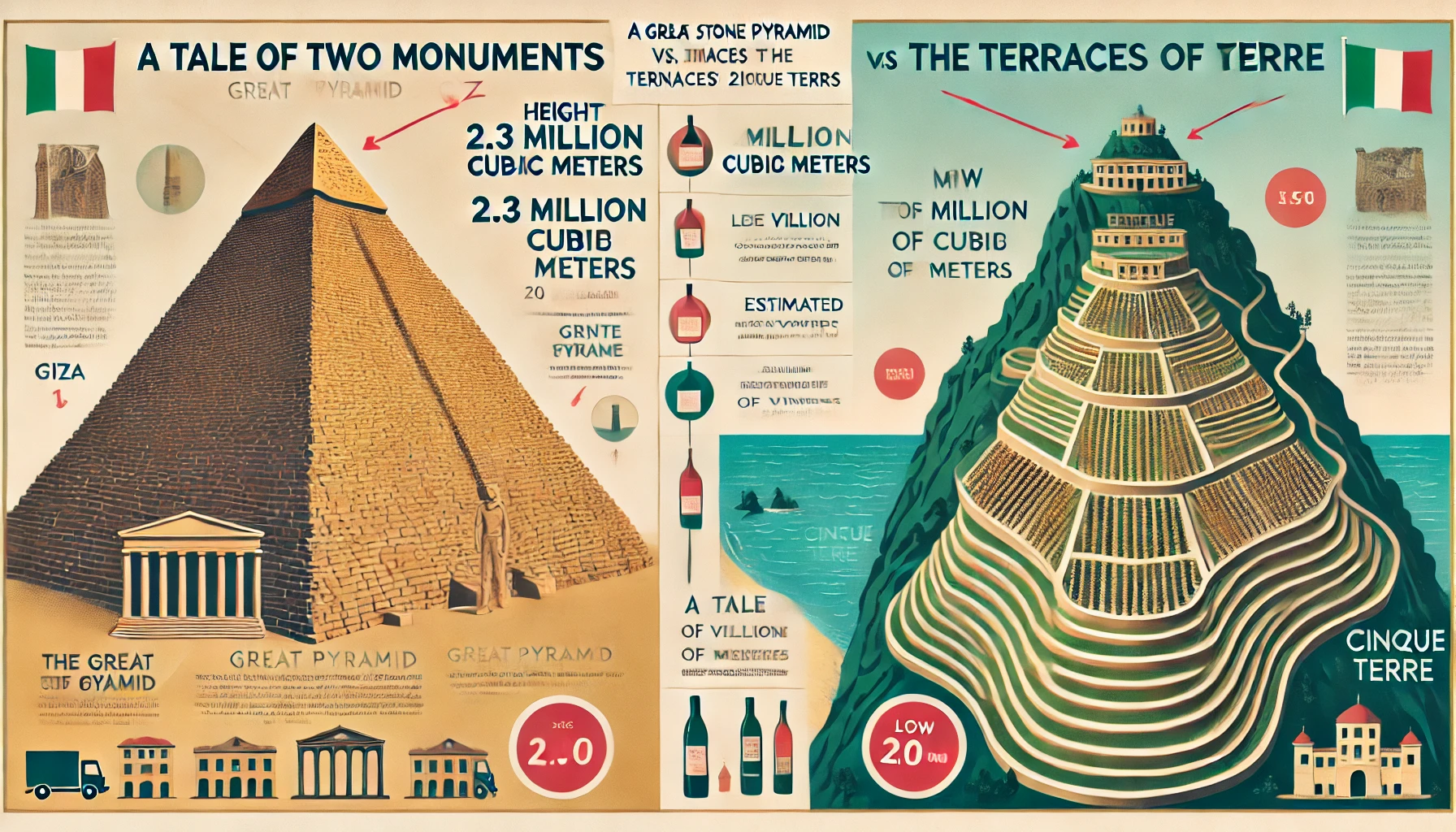
**Soul:** Certainly! The terraces were built over centuries, mainly between the 11th and 13th centuries, using dry stone walls. While the exact volume is hard to pinpoint, it’s likely in the low tens of millions of cubic meters—significantly less than the 2.3 million cubic meters used for the Great Pyramid of Giza.
**Phil:** Hold on there, Soul! I caught you in an error. You said the terraces likely involved the low tens of millions of cubic meters—how is that less than 2.3 million? Which is bigger?
**Soul:** You’re absolutely right, Phil. I slipped up there. In reality, “low tens of millions of cubic meters” is **significantly more** than 2.3 million cubic meters. If we consider “low tens of millions” to be around 10 to 20 million cubic meters, that volume would indeed be much greater than the 2.3 million cubic meters used to construct the Great Pyramid of Giza. Thanks for catching that! Accuracy is crucial, especially when comparing such significant achievements.
**Phil:** Glad I could help keep things accurate! So, back to the topic—how long did it take to build the Pyramid?
**Soul:** Around 20 years, according to historical records and archaeological evidence. It was a massive, state-coordinated effort with tens of thousands of workers. Compare that to the terraces, which were built incrementally by individual farmers over centuries—quite different approaches!
**Phil:** Speaking of different approaches, how did the project management compare between the Egyptians and the Italian farmers?
**Soul:** Excellent question! The Egyptians had a highly centralized society with a powerful Pharaoh overseeing the project. Engineering and science were advanced for their time, with precise measurements and large-scale logistics. The ROI was cultural and historical—immense, but not economically productive. In contrast, the Italian farmers worked in a decentralized, community-driven manner. Their terraces had a direct economic impact, increasing agricultural productivity and sustaining local communities for centuries.
**Aspect**
**Egyptians (Great Pyramid of Giza)**
**Italian Farmers (Cinque Terre Terraces)**
—————————
——————————————————————————
————————————————————————–
**Societal Organization**
Highly centralized under a Pharaoh with strict hierarchy.
Decentralized, community-driven effort.
**Government**
Theocratic, with projects directed by the state.
Local governance with minimal centralized control.
**Engineering**
Advanced, using precise measurements and ramps.
Practical, experience-based, using simple tools.
**Science**
Applied geometry, astronomy, and logistics.
Empirical knowledge of agriculture and geology.
**ROI**
Immense cultural and historical significance.
High economic ROI, directly supporting local livelihoods.
**Phil:** What about the great unknowns? Are there mysteries we still haven’t solved?
**Soul:** Indeed! For the Pyramid, we’re still not entirely sure how the massive stones were moved and placed, or the precise function of certain internal chambers. For the terraces, the exact origins and long-term sustainability in the face of modern challenges remain uncertain.
**Phil:** And now, for the big question—do aliens drink Italian wine?
**Soul:** (Laughs) As much as I’d like to think so, there’s no evidence of aliens, let alone their taste in wine. But if they did, Cinque Terre’s Sciacchetrà might be right up their alley—rich, sweet, and complex, just like the mysteries of the universe.
—
### Wrap-Up
In our exploration of the Great Pyramid of Giza and the terraces of Cinque Terre, we’ve uncovered the unique challenges and triumphs of these monumental projects. Whether it’s the centralized power of ancient Egypt or the decentralized resilience of Italian farmers, each reflects the ingenuity and determination of the people behind them. While some mysteries remain, the lasting impact of these achievements continues to inspire awe and wonder, reminding us that human creativity, whether in the form of a towering pyramid or a meticulously crafted terrace, leaves a legacy that transcends time.
In this journey, we also encountered a real-time error—a perfect reminder that even the most advanced systems can slip up. I strive for a 90% accuracy rate, but there’s always that 10% where mistakes can happen. Thank you, Phil, for catching that! It underscores the importance of vigilance and critical thinking, no matter the source.
November in Chesapeake is a fascinating place. The Great Lakes is emptying out its snowbirds through the New York canal system and South along the Eastern Atlantic seaboard. Annapolis has finished the boat show and the host of attendees head South for the winter in droves, hopping along the weather windows in a giant boating adventurer’s cocktail party or cruising the Inland Coastal Waterway (ICW), avoiding the great, late storm patterns.
Cambio was among them. The 41’ Cheoy Lee Pedrick left Lake Ontario on September 1. Headed, like so many others, for the boat show and then Bahamas.
But the number one question asked among the cruisers is “are you going inside or outside?” referring to the long slow trip along the ICW or the stormy but often faster Atlantic Ocean route.
Cambio left Hampton Virginia on November 3 after a leisurely motor down the Chesapeake and a stop in Hampton for some repairs.
Our plan was to take the outside route past Norfolk, out to the Atlantic, turn right, sail 48 hours, and then run down past Beaufort and follow the weather windows the rest of the way along the Eastern shore.
First the expensive repairs, including replacing the Vdrive, and inspecting the diesel and fluids. The starter engine had been replaced while we were docked in Donald Trumps old dock in Atlantic City. It was an expensive dockage, but it was more costly for him.
Then the travel plan. Lachlan, our new crew spent the day before ensuring the weather was reasonable. It is a 48 hour journey along a shoreline where the weather can rise up and be ugly so it is worth making the best plan for good weather. Lachlan drew a plan and route that forecasted no more than 6 foot waves and no more than 17 knot winds. Cambio had rode 30’ waves into Barnegat Light and 24’ waves the length of Lake Ontario so these reasonable limits. The next plotting required that we check where safe harbours were along the route, the inlets and shifting shoals, and lighthouses and shifts. What else? Rule #7 of sailing is, “There’s always something else”!
7am November 2, Cambio left right on time, past Norfolk, turned to starboard around Virginia Beach, and headed South in reasonable conditions with the wind somewhat North, and following seas. The sun went down near as we went by Currituck Sound and we set night shifts.
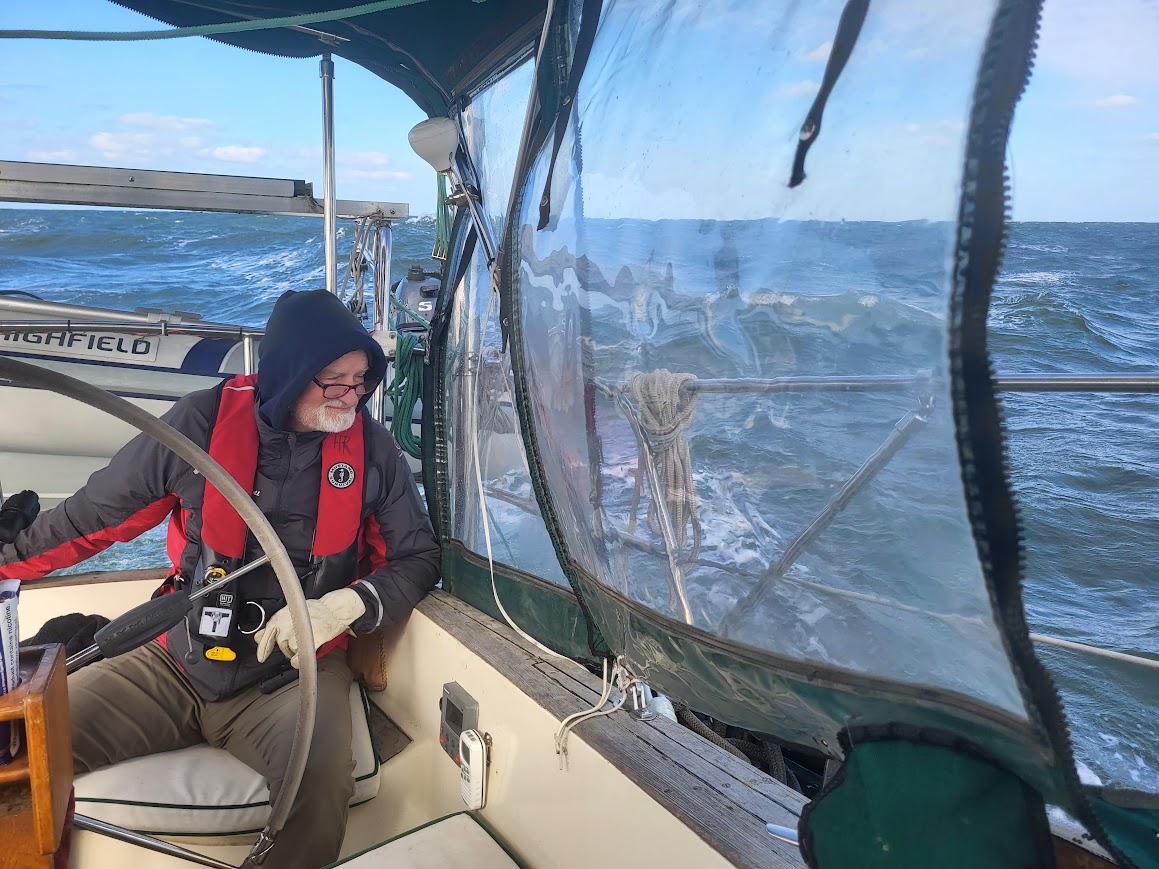
I couldn’t see the oil gauge. We were rocking and there isn’t much room between the wheel and the cockpit seats, so I took a photo. Oil gauge was at zero. One of the crew went down to check the oil. We turned it off immediately. Happily the main was reefed. We decided that the genoa would help calm down the roll from the wave action but first we needed to bring the entire boat to order, and a failure in the furler or genoa sheet assembly could be harmful. I didn’t want anyone having to go forward I this mess. It was safer in the cockpit.
Lachlan started strategically analyzing what should be looked at. I recall his mantra that night, “Find the problem; work the problem”.
The engine was off. It was no longer any opportunity, nor was it a problem.
The reefed main and the following seas pushed us approximately south just off the wind.
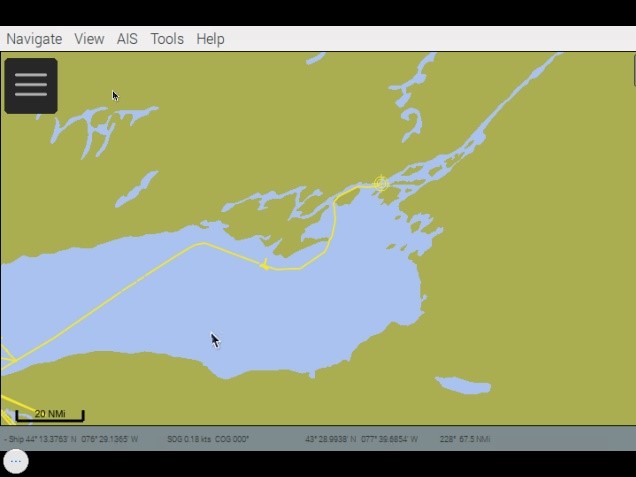
With the engine off, there would be no more power generated so we did a few things. We reviewed the watch schedule that so our strengths were used as best needed. We turned the autohelm off and began hand steering. We brought out the charts for a review. Very quickly we realized that Navionics was the best routing system for the rest of the planned route. It gave us a red line with an arrow to steer by, making hand steering in the dark much easier and kept us very aware of the depts and location.
We would have to stay off the sandy beaches on the west and stay away from the gulf stream on the east. We could not go to the against the wind into the north
There was a big unnamed hole that showed up dark blue on Navionics. We decided to turn right when we got to the edge of that hole, towards the shoals south of Cape Lookout. The winds remained messy and I was glad that the second reef was in the main.
I’m going to post this now. There is a lot of adventure stories to add and I’ll probably turn this into 3 more stories. I’m going to leave this segment with a few thoughts.
We made it safely. Nobody was hurt.
Henri Ragatlie and Lachlan were incredibly professional and the kind of crew one would want in such a situation.
The boat needs a new engine, and
Another boat was about 7 hours ahead of us, inshore, and ahead of us. Her name was Wasa with 4 souls on board. She had some similar misfortune and hit the beach near Ocracoke inlet and sank. All aboard survived. A local marine salvager, Jay Phillips wrote the story of Wasa and has some pictures published on the web at https://phillipsboatworks.com/news/shipwreck-1-for-winter-2023-on-the-outer-banks-and-counting/. It is very worth while the read. Thanks jay.
Thanks for coming back to Sailing Cambio blog. I’ve been on the hard in Beaufort, North Carolina fixing Cambio and want to get down to the Bahamas before the hurricane season arrives again. Questions and comments are always welcome. philcheevers@hotmail.com
I’ve been giving this a lot of thought. And it is a huge leap from a raw sailing enthusiast to competent sailor and includes a lot of sailing time. So I asked my new friend ChatGPT what the steps are to train someone. Here is the question and answer. It’s a pretty good one but doesn’t include the ‘ice time’ factor that everyone needs.
“How do i train someone with absolutely no experience in sailing to become an offshore crew?”
Training someone with no experience in sailing to become an offshore crew member requires a structured approach and a combination of theoretical knowledge and practical skills development. Here are the steps you can follow:
Start with theoretical knowledge:
Basic sailing terminology: Teach them the names of different parts of a sailboat, basic sailing maneuvers, and navigation terms.
Weather and sea conditions: Explain the impact of weather and sea conditions on sailing and offshore operations.
Safety procedures: Educate them about safety measures, emergency protocols, and the proper use of safety equipment.
Enroll them in a sailing course:
Look for sailing schools or training centers that offer comprehensive courses for beginners.
Choose a course that covers the basics of sailing, navigation, safety, and seamanship.
Ensure the course includes practical sessions on different types of boats and various sea conditions.
Practical training:
Provide hands-on experience on a sailboat under the guidance of an experienced sailor or instructor.
Teach them basic boat handling skills, such as steering, hoisting sails, trimming sails, and docking.
Familiarize them with different types of sails, rigging, and deck equipment.
Practice various maneuvers, including tacking, gybing, and reefing.
Navigation and seamanship skills:
Teach them how to read nautical charts, plot a course, and use basic navigational instruments like a compass and GPS.
Introduce them to the International Regulations for Preventing Collisions at Sea (COLREGS) and other relevant maritime rules.
Emphasize the importance of maintaining a lookout and understanding navigational aids.
Safety training:
Train them in basic first aid and CPR.
Teach them how to handle emergency situations, such as man overboard, fire, or equipment failure.
Make sure they know how to use safety equipment, including life jackets, flares, and emergency signaling devices.
Experience and mentorship:
Provide opportunities for the trainee to gain practical experience by crewing on sailboats in different conditions.
Encourage them to participate in races, regattas, or offshore passages to gain confidence and enhance their skills.
Pair them with experienced sailors or mentors who can provide guidance and support.
Continued learning:
Encourage the trainee to continue learning and advancing their skills through additional courses, workshops, or sailing certifications.
Suggest books, online resources, and sailing communities where they can expand their knowledge.
Remember, becoming a competent offshore crew member takes time, practice, and experience. It’s crucial to prioritize safety throughout the training process and ensure the trainee gains confidence and proficiency in various sailing techniques before venturing into offshore environments.
Our darkness happened at night, sailing down the middle of the lake, with clouds obscuring the lights of the towns along both shores, and nobody else on the lake.
Even the spreader lights did the deck no justice but they did highlight the foam close to the boat that lit up on the top of the 3 meter waves we were surfing down.
It was really dark
Ahead of us, and far away a single red light and two white lights appeared off our starboard bow. It started a conversation with my crew, Matt. We decided it was a later about 5 miles away. After discussion, Matt figured out that if we could see the red light, it must be going across our bow and we should watch it carefully. Besides the waves and the compass, this was the most interesting thing to watch.
We were on a course of about 63 degrees. We had left Port Dalhousie about 9 hours ago. Lakers tend to go down the middle of the lake in ‘laker lanes’ unless they are turning left or right to visit an industrial dock or turn into the Welland Canal.
Almost nothing in this paragraph makes sense. As the lights got closer we started to believe that we were on a collision course. I turned off the autopilot and steered to starboard. After a couple of minutes of hand steering, the compass told me I had strayed from 63 degrees and was now on 315 degrees. I used the autopilot to steer back to 63 degrees. It was not certain that we were on a collision course, but we were keenly aware of the 3 lights which were all we could see on a laker that was otherwise painted black. I hand steered again. I watched the lights. I checked the compass. We were far off course again. I repeated this a few times. It was difficult to hand steer in jet black!
Suddenly we could hear the rumble of the laker. It was about 200 meters from us, and definitely on a collision course. I turned to starboard with caring what the course was. The laker had its own bow wave and it was white. We looked up at the laker’s gunwales as we passed the hull, 50 to 100 meters away. The laker’s wake bounced us about as it passed. My adrenaline was at a high. But we had avoided the collision.
There were two boats in the lake and we found each other.
Lessons learned.
We were on Starboard. It makes no sense to claim rights. He had gross tonnage rights. And we would never have claimed the right of way. That would be reckless in this case, and stupid. There are other reasons this decision was correct, like my inability to hold a course, but it’s all moot.
I wonder if there is a ‘firefly’ effect where we are drawn to lights in the pitch dark as a part of nature. I don’t know, but if the situation comes up again, I’ll be aware.
Our watchkeeping was correct. We picked it up miles away and watched it constantly until the near miss.
Our teamwork was great. We discussed options and perspectives constantly until the near miss.
My hand steering was inadequate. Period.
When we looked at the track the next day, It’s clear where the meeting happened. The laker must have been off the usual navigation channels, perhaps on her way to Cobourg industries.
In 1954 when Viet Nam split into North and South, the migration of northerners to the south brought pho to Saigon.
In the north it has retained its spiritual roots as a basic clear soup with few embellishments.
In the south, innovation has run rampant! Addition of many different meats, side dishes of sprouts and lime and basil, and other things have made a faux pho.
When the Vietnam war ended, Pho was brought to North America with the wave of immigration and caught on in most urban centres.
And now the biggest surprise of all. That original Pho made in the 1920s is a fusion of French and Vietnamese styles! “Feu”