Category: Sailing

  • Are you looking for bucket list, gap year, or just plain adventure?

    Are you looking for bucket list, gap year, or just plain adventure?

    Are you ready for the ultimate adventure that will leave you breathless? Picture yourself sailing across the vast ocean, exploring uncharted territories, and discovering the hidden wonders of the world. Look no further! We are in search of an intrepid soul to join our crew on an epic journey aboard the magnificent Cambio, a majestic 41′ Cheoy Lee sailboat. Departing from the awe-inspiring Lake Ontario in August, our expedition will culminate in the mesmerizing Bahamas by December.

    As a vital crewmate, you will immerse yourself in the exhilarating experience of life at sea, mastering essential sailing skills, and unraveling the secrets of each destination we encounter. Side by side with a seasoned captain and crew, you will embrace the thrill of navigating the uncharted waters, maintaining the vessel with precision, and embracing the daily wonders of life onboard.  Sign on for 2-3 months or longer. 

    But the adventure doesn’t end there! Once we reach the captivating Bahamas, we will set our course towards the spellbinding US Virgin Islands and beyond. And in May 2024, we will embark on an epic journey to the enchanting Azores. This extraordinary opportunity is an absolute must for anyone craving adrenaline, seeking personal growth, and yearning to forge unforgettable memories.

    Discover the heart and soul of Cambio and learn more about our awe-inspiring voyage by visiting www.sailingcambio.com. We seek individuals who possess unwavering dedication, a thirst for adventure, and an undying love for the sea. Don’t let this opportunity slip away! Dare to join us on this epic quest and experience the sheer exhilaration of conquering the open ocean. Apply now and become an indomitable member of our crew!   philcheevers@hotmail.com or +1 905 321 2291
  • There’s always something…and it is on Cambio

    There’s always something…and it is on Cambio

    The tasks seem to be getting smaller these days, thanks to Jeff and other people who chipped in. This is good.  The big tasks are dwindling and the remainder of the tasks are either a few big ones that are taking a normal amount of time or small ones in which finding the right tool often takes longer than doing the task…and then putting it away again. 

    Here’s a sample of what we did over the last couple of days, without mentioning the raspberry pie systems development that Jeff is doing. Stay tuned for some amazing developments in boating systems by Jeff.  

    • Tune the shrouds
    • Add opening strings to make the bifold doors open easily.
    • Installed new VHF extension cord to the steering station
    • Installed the lazy jacks
    • Installed the vang
    • Replaced the windlass battery (thanks Fred)
    • Installed reefing lines
    • Fixed 3 of 5 mast lights (thanks Fred)
    • Freezer is adjusted right on
    • Ordered parts for toilet
    • Removed the broken SSB radio
    • Cleaned some spare lines
    • Secured dinghy on Davits for rough weather
    • Fixed and installed new boarding ladder. (Thanks Keith)
    • Tested windlass
    • Fixed power on chart plotter

    However, as Pierre coined, rule #7, “There’s always something else”.

  • Progress is happening

    Progress is happening

    Today is May 19 and we progress.  

    We progress on preparing the boat, we progress on the relationships we build, we progress on our health, and we advance on our dreams.    

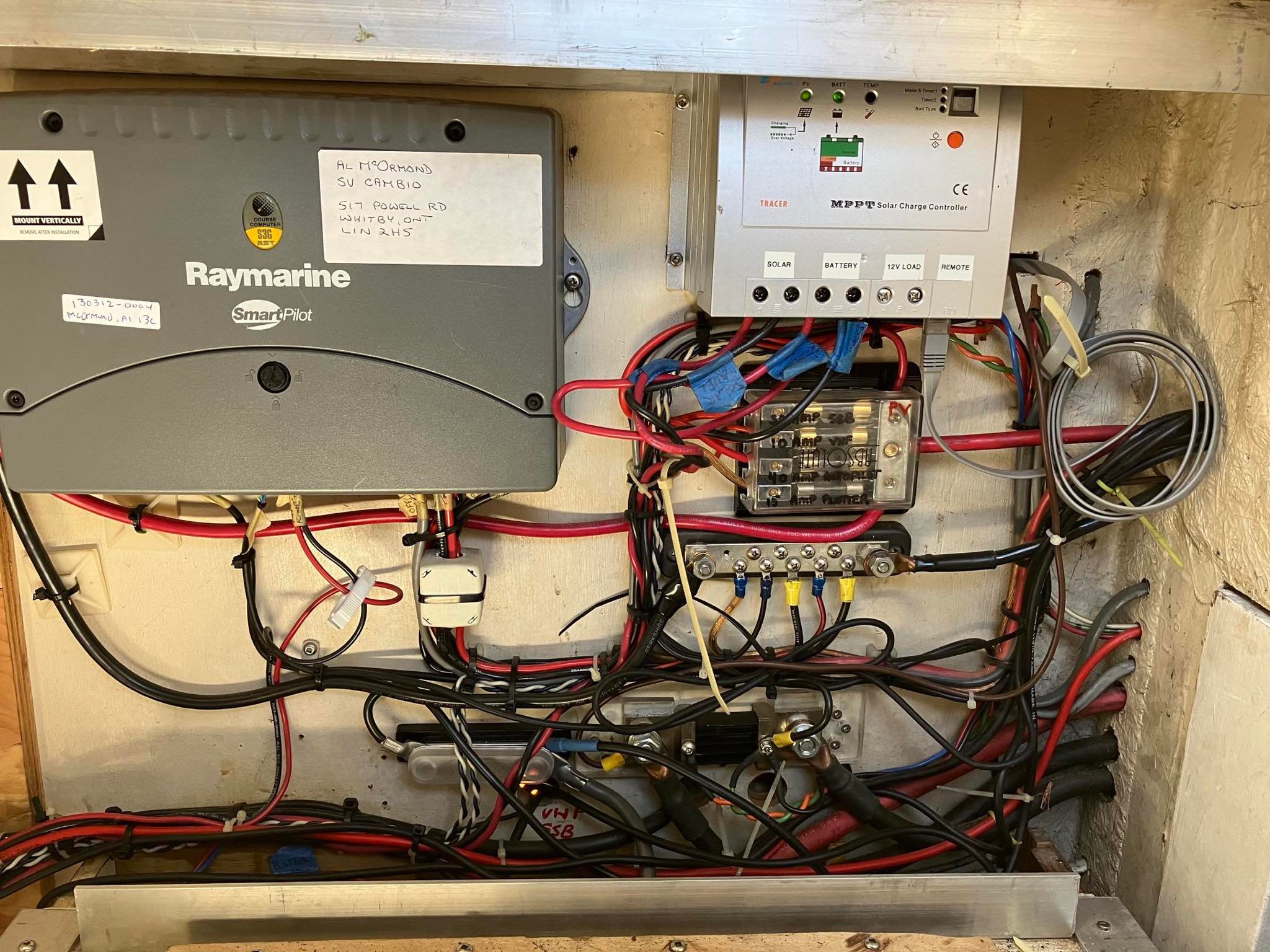
    My brother is up here for a few weeks and he has brought energy and focus with him.  Today we did some space management, Prepared the dingy, fixed the safety bridal for the motor, removed the VHF remote wire and ordered a new one, started getting the Starlink installed and a host of smaller incidental jobs.  We did another calculation on the new solar panel plans and went over the system design, which now includes, raspberry pies, a Raymarine legacy system, androids, Ipads, openCPN, and a host of other things. 

    To put it in perspective, I did the space management and got the screwdrivers when my brother needed them.    I’m pooped.  

    It’s good to be busy but besides the maintenance and preparation, there’s a lot of other things that I’m going to have to address over the next week.   I have some side hustles that will make this boat trip a pleasure.  I’m also helping some of the prospective crew with their side hustles.  Marketing, writing, and promotions are necessary.  

    So is recovering from the bilateral knee replacement 4 months ago.  It is getting less and less painful, but there’s aways that moment where I hesitate, knowing that getting up will hurt but it must be done so I do it.  The hurt is less and less each week but I’m tiring of the pattern.

    It will rain tomorrow and that will shift all of our efforts into the cabin, which is fine.  We have a long list of things to do both inside and outside.  

    Tonight the rum and the cigars were a treat.   Now I need some sleep.  

  • Recruits to Able Seamen.

    Recruits to Able Seamen.

    I’ve been giving this a lot of thought. And it is a huge leap from a raw sailing enthusiast to competent sailor and includes a lot of sailing time. So I asked my new friend ChatGPT what the steps are to train someone. Here is the question and answer. It’s a pretty good one but doesn’t include the ‘ice time’ factor that everyone needs.

    “How do i train someone with absolutely no experience in sailing to become an offshore crew?”

    Training someone with no experience in sailing to become an offshore crew member requires a structured approach and a combination of theoretical knowledge and practical skills development. Here are the steps you can follow:

    1. Start with theoretical knowledge:
      • Basic sailing terminology: Teach them the names of different parts of a sailboat, basic sailing maneuvers, and navigation terms.
      • Weather and sea conditions: Explain the impact of weather and sea conditions on sailing and offshore operations.
      • Safety procedures: Educate them about safety measures, emergency protocols, and the proper use of safety equipment.
    2. Enroll them in a sailing course:
      • Look for sailing schools or training centers that offer comprehensive courses for beginners.
      • Choose a course that covers the basics of sailing, navigation, safety, and seamanship.
      • Ensure the course includes practical sessions on different types of boats and various sea conditions.
    3. Practical training:
      • Provide hands-on experience on a sailboat under the guidance of an experienced sailor or instructor.
      • Teach them basic boat handling skills, such as steering, hoisting sails, trimming sails, and docking.
      • Familiarize them with different types of sails, rigging, and deck equipment.
      • Practice various maneuvers, including tacking, gybing, and reefing.
    4. Navigation and seamanship skills:
      • Teach them how to read nautical charts, plot a course, and use basic navigational instruments like a compass and GPS.
      • Introduce them to the International Regulations for Preventing Collisions at Sea (COLREGS) and other relevant maritime rules.
      • Emphasize the importance of maintaining a lookout and understanding navigational aids.
    5. Safety training:
      • Train them in basic first aid and CPR.
      • Teach them how to handle emergency situations, such as man overboard, fire, or equipment failure.
      • Make sure they know how to use safety equipment, including life jackets, flares, and emergency signaling devices.
    6. Experience and mentorship:
      • Provide opportunities for the trainee to gain practical experience by crewing on sailboats in different conditions.
      • Encourage them to participate in races, regattas, or offshore passages to gain confidence and enhance their skills.
      • Pair them with experienced sailors or mentors who can provide guidance and support.
    7. Continued learning:
      • Encourage the trainee to continue learning and advancing their skills through additional courses, workshops, or sailing certifications.
      • Suggest books, online resources, and sailing communities where they can expand their knowledge.

    Remember, becoming a competent offshore crew member takes time, practice, and experience. It’s crucial to prioritize safety throughout the training process and ensure the trainee gains confidence and proficiency in various sailing techniques before venturing into offshore environments.

  • Natty Genco Canvas Boat Cover for Sale

    Natty Genco Canvas Boat Cover for Sale

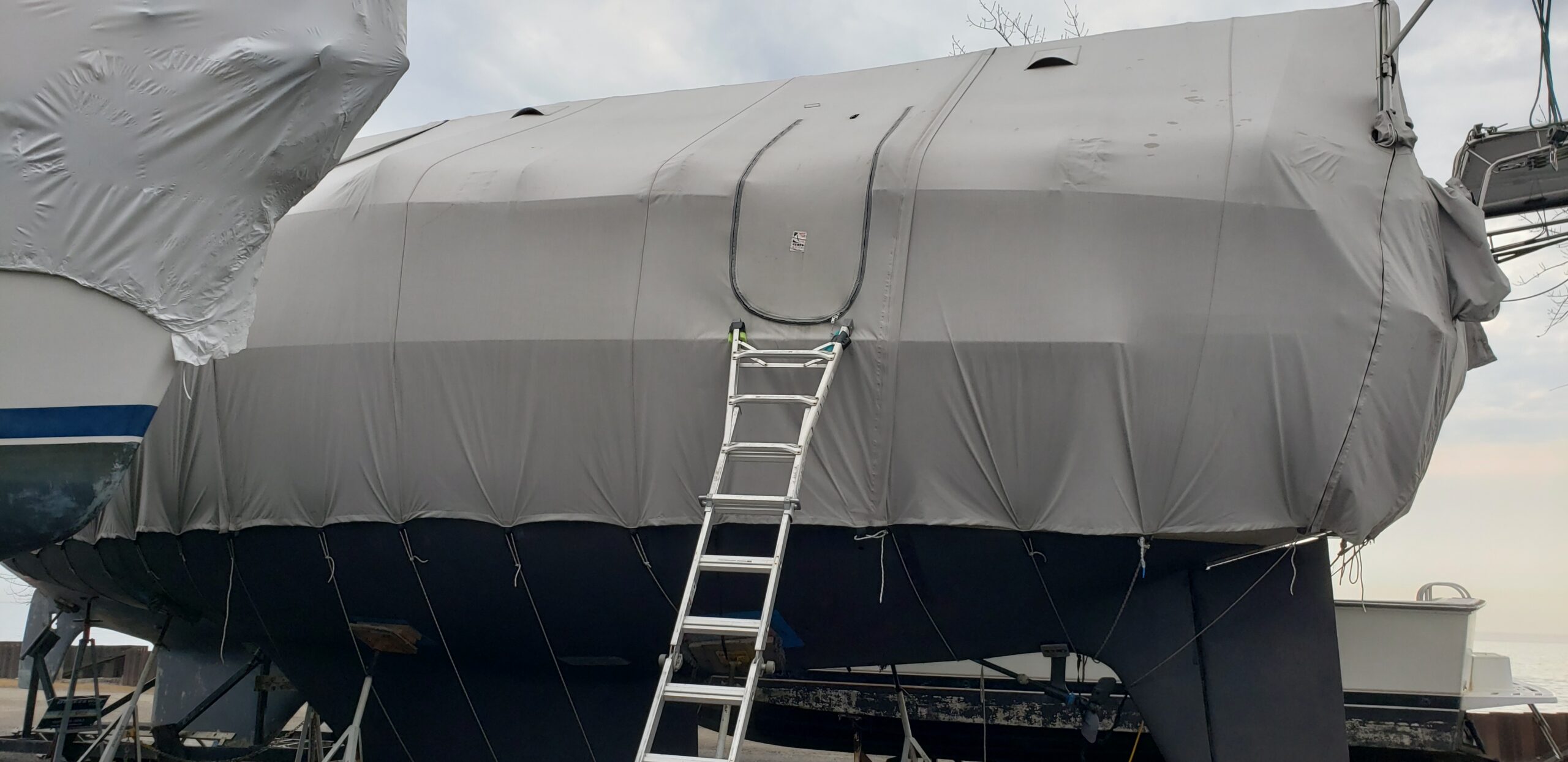
    As we get ready to go south, we won’t be needing the boat cover and we are offering the Genco canvas cover for sale. We just won’t need it for a few years.

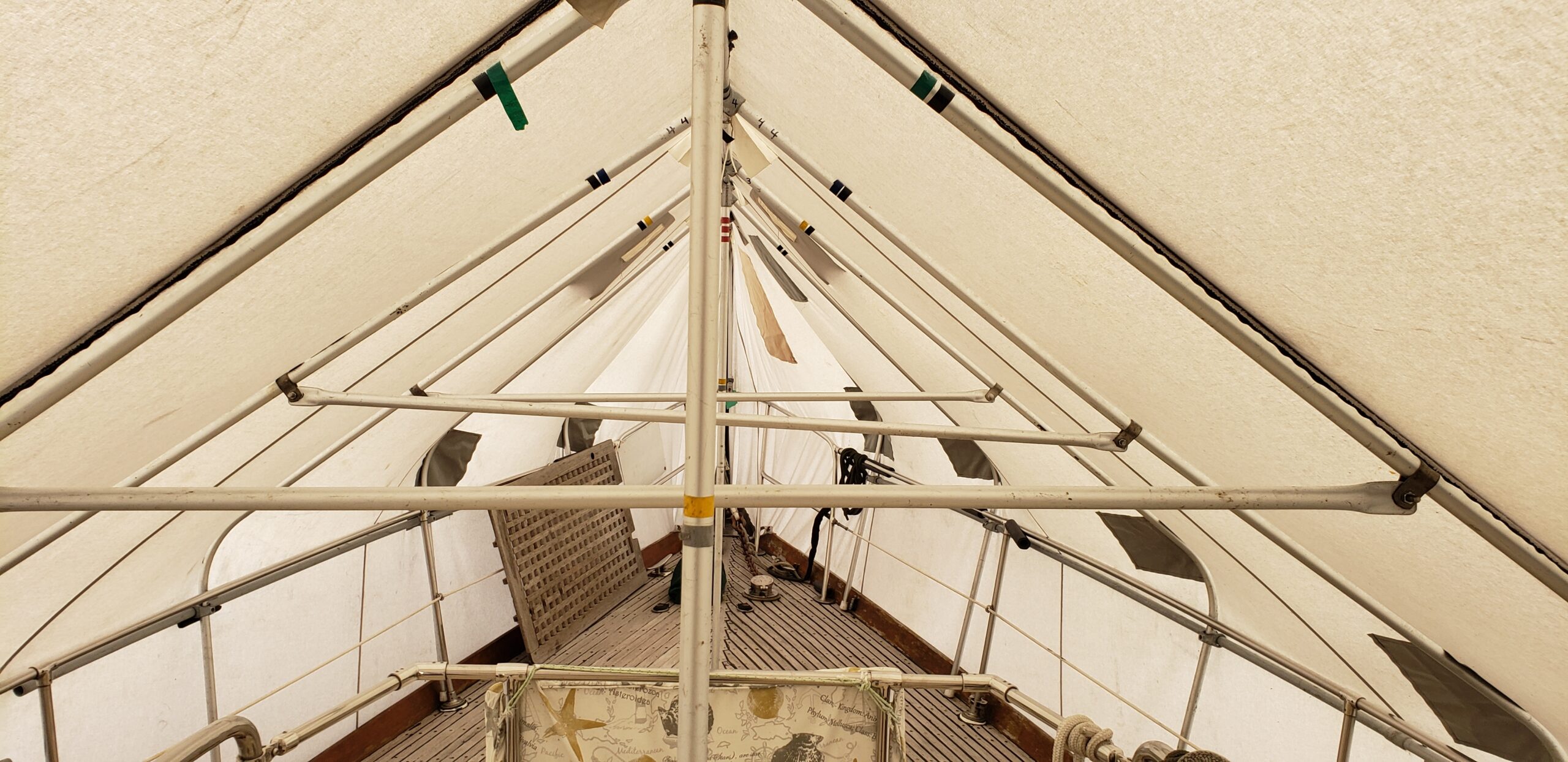
    It comes with an aluminum frame and completely covers the gelocoat topsides. It is available in St. Catharines, Ontario. It is in great shape.

    I called Genco, who made it originally. They quoted me just over $7000 for the new boat cover for the 41′ Cheoy Lee Pedrick fiberglass boat.

    I’m asking half price, $3500. It is in great shape and covered the boat last year perfectly.

    Please Call 905 321 2291 to inquire.

  • From Cold Sweat to Adventure: How Filling Out a CPP Form Changed My Life

    From Cold Sweat to Adventure: How Filling Out a CPP Form Changed My Life

    I was sitting at my desk filling out my Canada Pension (CPP) Form.  The form has an area at the top for personal information and a bit more.  It has a big area of small text that I’m sure very few people read.  At the bottom there is a place for a signature and date. 

    I filled out the top, skipped over the middle, and hovered my pen on the signature place at the bottom. 

    Now signatures are permanent where the government is concerned, but that wasn’t really what brought out a cold sweat on me.  

    My first thought was a loud (in my head), “Is that all there is?”   followed by that cold sweat.   I was not liking what I was doing because it occurred to me that I had no long term plan.   

    A few days later the same feeling hit me but this time there was a cold sweat followed by a “F*ck NO!  I still have one more ride in me!  Maybe two or three!”  Self-talk can be powerful when it is piled on with “positive self-talk”

    I began to realize that I had loved competitive and cruising sailing for the last 30 years.   I had loved photography for the last 10 years.  I loved traveling.  I loved taking on new and difficult tasks.    

    It took a month or so to study what was involved in getting a boat again, going for a long sail, and basically doing one more startup with a crew, a goal and all the business stuff like budgets, timelines, and the dreaded critical breakdown structures.    

    Out of this horrible realization, followed by a pile of constructive thought process, and research came my next step, which was post CPP.   

    That’s how Sailing Cambio was born two and a half years ago.    I’ve now bought the boat, spent a summer season getting practical cruising experience on a new boat.  I’ve mapped out where I want to sail to.   I’ve given some deep thought on what kind of photography I want to do, and to end up doing something that I’ve never done before.   

    All due to the cold sweat of a significant signature on a CPP form. 

    And that is why I’m bringing the boat up to near mechanical ‘perfection’; began recruiting sailors with adventure in their souls; spent two winters mapping out cruising waters and learning all I can from YouTube, reading, talks with experts and by doing.

    The adventure started 2 and a half years ago and the next step is preparing the boat for launch in a few days, then cleaning, maintenance, and sea trials which will start a second season of big boat cruising experience on Lake Ontario. 

    Then September 1 or so the boat and crew leaves for the Caribbean to start the adventure. 

    All because I was shook up by the very officious signature.   It didn’t turn out so badly after all. 

  • 2023 Splash Prep, Christmas in the cradle, and Cover for Sale

    2023 Splash Prep, Christmas in the cradle, and Cover for Sale

    Cambio is arranged to splash April 24, which is pretty early but I can’t wait for the season to start.   

    I’ve got a half a list that contains the things that must be done before the boat goes in the water.  They, of course are priorities.     Then there’s the longer list of things that can be done after the boat goes in the water.   They are less priorities, but I have longer time to do them.  This means that the priorities on the post splash list tend to be a bit looser, and every day I add more to the post splash list. 

    Both my knees are complaining about the knee replacements 8 weeks ago and they are complaining loudly.  I can climb the 12 foot ladder but I’m not so steady coming down and I don’t want to be working there alone yet.  So the village has come together to help me out and I’m very thankful.

    Thanks to Tyler, Fred, Sam and Rob, who got the Genco cover off yesterday.  Today Henri did most of the puzzle solving by putting the bimini together.   Keith has fixed the ladder so that it drops further into the water, making it easier for crew to get out of the water.  Keven is replacing some halyards and making  up some other lines that are needed for replacement.

    When the boat is coming out in the fall, enthusiasm has waned with the approaching winter and boat putaway is somewhat sloppy.  But when spring is approaching and after that a fantastic sailing season to be followed by a fabulous adventure in the Caribbean, there is no waning, just raining, as we get the boat back into Bristol Shape. 

    And it was a bit like Christmas today.   I’ve been hunting through returns centres and salvage places looking for stuff for the boat at cheap prices.  Some of these I wouldn’t buy if they were close to regular prices, but the deals have been too good to pass up.    I got a set of walkie talkies for 5 bucks.  The second set was 3 bucks.  The moisture meter was just 5 bucks.  A 30 litre waterproof bag was just 5 bucks.  And so on.  I brought the first pack to the boat today.  I had forgotten all the great items I’d gotten and it was like Christmas opening them up, and then a bother trying to find the right space to store them in.   It will all work out.

    Speaking of the Genco cover, it is for sale.   I’m not going to need it for the next 3 years at least so it is a fine tarp cover with frame for a 41’ boat available for pickup in Niagara, Canada.   I also have adjustable stands (7) to support Cambio for sale.  Inquire anytime. 

    /

  • Cambio’s Tentative Trip South Fall 2023

    Cambio’s Tentative Trip South Fall 2023

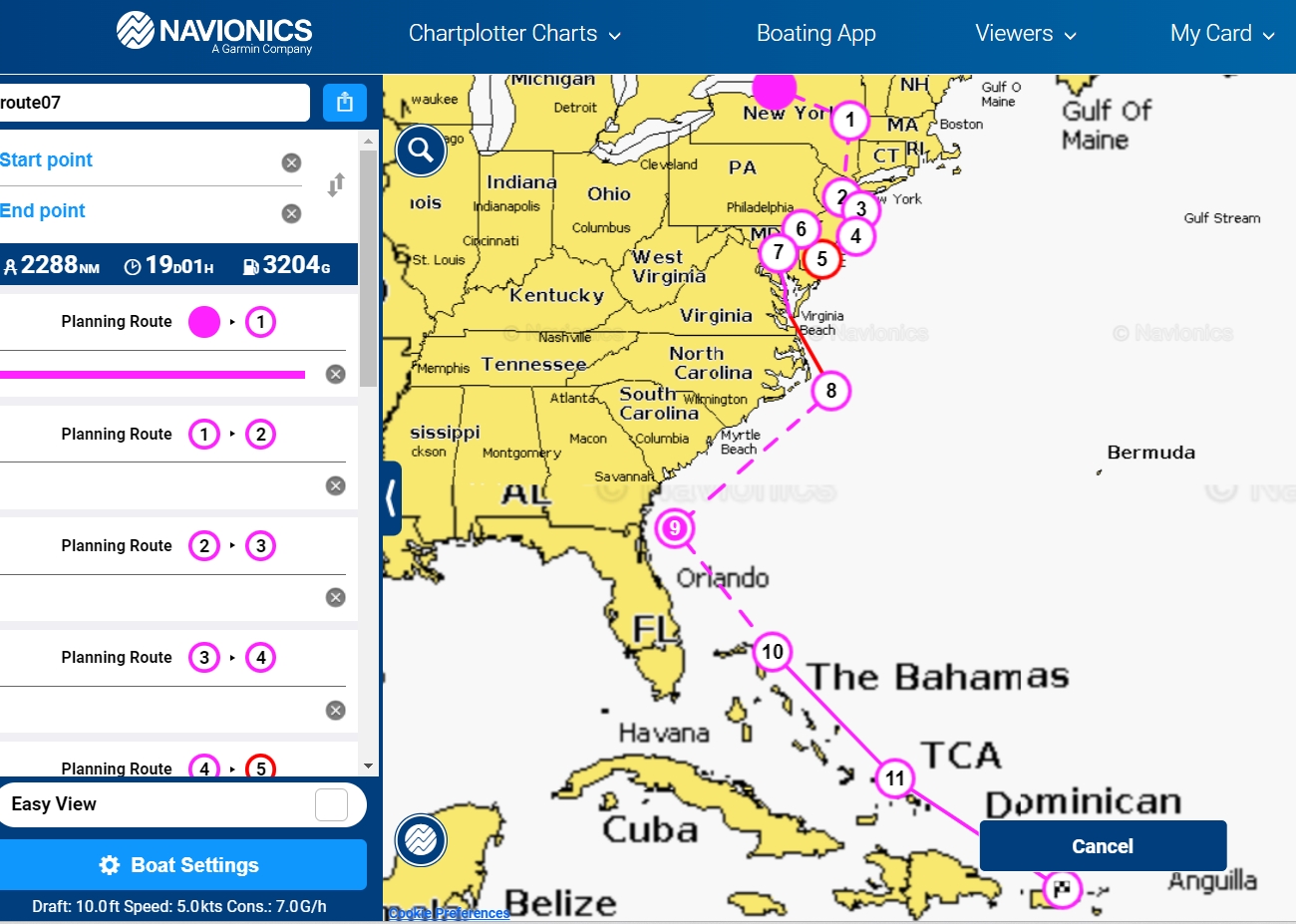
    I’ve posted on the Fall/Winter plans before, and I’ll probably do it again as we learn more and more about the routing from Lake Ontario to Puerto Rico. 

    Why Lake Ontario?  Because that’s where we are now.  

    Why Puerto Rico?  Because it is a convenient are to do some R&R after a trip of more than 2150 nautical miles.  

    R&R isn’t crucial because we are taking our time to get there.   Critical dates include

    September 1      Leave Oswego in the Erie Canal

    October 12         Annapolis Boat Show

    October 16         Leave for the south.  Use the ICW sparingly and when out in the Atlantic, avoid Hattaras near Pamlico Sound and Frying Pan Shoals near Wilmington.

    November 1       Arrive at St. Augustine.

    November 5       Arrive at Bahamas.   Play in the sand for a while.   

    December 1       It is still 1000 nm to Puerto Rico.  (See the “Thorny Path”   At 100nm per day that’s 10 days non stop.   There will be stops along the way; Crooked Island, Mayaguana, Turks & Caicos, Puerto Rico.  That last leg is a long stretch, probably upwind, but my insurance company doesn’t want me to go to Dominican Republic.  I’m going to have to negotiate with them. 

    And if we get there for January 1, a month later, it means we had a great time. 

    Until sometime In May we’ll visit the lesser Antilles, which include all the Virgin Islands, Monserrat, St. Martin, the Islands in between.  Plans to be devised. 

    Now pay attention.  This will probably change as we get closer to planning.  

  • Boat maintenance: the 55-point skipper’s checklist

    Boat maintenance: the 55-point skipper’s checklist

    • Katy Stickland compiled this list for Yachting Monthly magazine and it is a great checklist for spring. I’ve posted it here so that I can find it in 2 weeks when I commission Cambio, and for next year when I do it all over again.
    • If it helps you, send Katy a note. Authors of good articles love to hear that stuff.

    The ultimate boat maintenance checklist to make sure your yacht is ready for launch and the start of the sailing season

    Check your rudder for hairline cracks or damage

    Boat maintenance: the 55-point skipper’s checklist

    Boat maintenance: Mast & Rigging

    Check all your standing rigging connections. Credit: Colin Work

    • The mast cap is out of sight, out of mind 99% of the time, but serves multiple functions: backstay, forestay, cap shrouds, radio antenna, nav lights, halyard sheaves. Rotate mast and boom sheaves to check they are not misaligned or worn by a bad halyard lead. Lubricate sheaves with WD40 or silicone grease.
    • Spreaders, gooseneck, mast heel, kicker, mainsheet and topping lift connections all need checking for wear, damage or corrosion.
    • Check for galvanic corrosion between different metals.
    • Check electrical connections, deck and spreader lights.
    • Wax mast tracks and luff grooves with candle wax or Teflon spray.
    • Standing rigging: Look for areas of wear or stranding on the wire. Check mast tangs, T-ball joints and rigging screws.
    • Wash furling drum and swivel and check they move freely. It’s common for the top swivels to become stiff and sometimes seize, which can compromise the forestay wire.
    • Running rigging: check for chafe and that the shackles aren’t seized. Sheets, halyards, warps: wash in fresh water to get rid of salt and grime.

    On Deck

    Below Deck

    Head, bilge & gas

    Check bilge pumps it might sound ok but is it actually attached to a hose?

    • Check impeller on bilge pumps and grease with water pump grease only (Vaseline will rot impellers)
    • If you have an automatic bilge pump, check float switches work.
    • Dry bilges thoroughly then if water appears after relaunch you’ll know you’ve got a leak.
    • Fill water tank and add purifier such as Puriclean or Milton
    • If the pump on the heads is stiff look to service and lubricate with silicon grease.
    • If you have a gas sensor, check it works.

    Boat maintenance: Below waterline

    Hull and skin fittings

    Check jubilee clips for rust. Credit: Bob Aylott

    • Most vessels have DZR (dezincification-resistant brass) seacocks. Look for any signs of corrosion on the skin and tail joints, which are common points of failure.
    • Ensure all valves are greased.
    • All hoses should be double-clipped. Check jubilee clips for rust. Do you have wooden plugs attached in case of emergency?
    • Check skin fittings are free of blockages/ growth or antifouling.
    • Check anodes have plenty of life. Don’t forget prop shaft and saildrive anodes.

    Rudder

    • Check leading, trailing and lower sections for damage or hairline cracks.
    • Check for play in bearings, stock or quadrant. Movement should be minimal. Grease steering cable.

    Keel

    • Check for stress cracks or movement internally and externally – especially at the keel root and around the internal framing or matrix, and around fastenings and backing washers.

    Prop shaft & stern gland

    • To check bearings, grasp prop in both hands and try moving it up and down and from side to side. There should be little, if any, movement – no more than 2mm.
    • Check P-bracket for stress cracking from misalignment or damage.
    • Stern gland packing. Many yachts have some form of deep-seal arrangement that has a service life of around seven years. Those that have a proper stuffing gland will need to be greased to prevent drying out and getting brittle. The gland may need pulling down or repacking at some point.
    • If you have a saildrive, check the condition of the seal and the metal ring that holds it in position. Again, note the seals have a life expectancy of between five and seven years depending
      on manufacture.

    Boat maintenance: Mechanics

    Engine

    Check all filters

    • If you didn’t change the oil when you laid up, change it now.
    • Change fuel filters.
    • Remove rags stuffed in outlet pipes from winterisation.
    • Impellers – if removed at lay-up – reinstall with a smear of water pump grease.
    • Reinstall the engine belts and check tension: there should be no more than half an inch of play.

    Saildrives

    • Check oil levels. Check durability of the gaiter seal. Check rubber faring and reseal if necessary.
    • Change internal engine anode.
    • Check engine mount is secure.
    • Check diesel tank for water from condensation. Drain off or replace fuel. Add an appropriate biocide to help kill off diesel bug.
    • Check inaccessible wiring, such as bonding wires from the anode and earthing wires from the starter motor. Clean the terminals and smear them with Vaseline or silicone gel.

    Batteries and electrical systems

    • Check electrolyte level if yours is an open lead acid battery; tighten battery securing straps and make sure vent for gases is clear. Clean terminals and coat with Vaseline. For sealed batteries, check the condition of indicator light, or other charge indicator.
    • Switch on instruments and use backlighting to help reduce any condensation.
    • If the anode looks serviceable for another season, check bonding and wires. If they haven’t worn at all they may not be working so check Ohm resistance max 0.2 from propeller to anode.

    Sails

    • Check for chafe, wayward stitching and tears. Do you carry a sail repair kit?
    • Take to a sailmaker if the sacrificial strips is worn out.

    Charts

    Make sure your navigation apps are up to date

    • Update charts from Notice to Mariners.
    • For electronic charts, check with your supplier how to update. New chartplotters can connect to WiFi, or you may need to connect the chart chip to your PC at home and download the update.
    • Download operating software updates for your chartplotter and instruments.
    • Make sure your subscriptions for navigation apps on phone and tablets are up to date with the latest charts.

    Safety

    Gas system

    • Check age of hoses. If they are over five years old, they should be replaced. Check for kinking or wear in gas hosepipes. If in doubt, replace.
    • Check hose clips are tight. Hoses behind cookers should be armoured.
    • Check thermal cut outs on hob, grill and oven work.

    Harness/lifelines

    • Check stitching and get repairs done by a sailmaker if necessary.
    • Jackstay and Danbuoy lines: check condition and points of security.

    MOB lights

    • If you have the traditional type, check the bulb, battery and that it actually works. The new types have various ways of testing, and all have an expiry date.

    Lifejackets

    Is your lifejacket fit for purpose and in good condition? Credit: Theo Stocker

    Stanchions/lifelines

    • Check stanchions and make sure lifelines are still suitably secured at each end and cords and pins are in good order.
    • Watch out for wire failing if you have plastic sheathing.

    Flares

    • Make sure these are in date, in a watertight container and are easy to reach. It’s worth having gloves and goggles to hand too.

    EPIRBS

    • Make sure these are in date and registered with the correct contact details.

    Liferaft

    • Ensure this and the hydrostastic release are within the service date, and you are aware of its contents.
    • If its secured with a rope, consider if you could release it in an emergency with ease.
    • Make a grab bag up with essentials
  • It was really dark

    It was really dark

    It was really dark.

    Our darkness happened at night, sailing down the middle of the lake, with clouds obscuring the lights of the towns along both shores, and nobody else on the lake.   

    Even the spreader lights did the deck no justice but they did highlight the foam close to the boat that lit up on the top of the 3 meter waves we were surfing down.

    It was really dark

    Ahead of us, and far away a single red light and two white lights appeared off our starboard bow.   It started a conversation with my crew, Matt.   We decided it was a later about 5 miles away.  After discussion, Matt figured out that if we could see the red light, it must be going across our bow and we should watch it carefully.   Besides the waves and the compass, this was the most interesting thing to watch. 

    We were on a course of about 63 degrees.  We had left Port Dalhousie about 9 hours ago.  Lakers tend to go down the middle of the lake in ‘laker lanes’  unless they are turning left or right to visit an industrial dock or turn into the Welland Canal. 

    Almost nothing in this paragraph makes sense.  As the lights got closer we started to believe that we were on a collision course.  I turned off the autopilot and steered to starboard.  After a couple of minutes of hand steering, the compass told me I had strayed from 63 degrees and was now on 315 degrees.  I used the autopilot to steer back to 63 degrees.  It was not certain that we were on a collision course, but we were keenly aware of the 3 lights which were all we could see on a laker that was otherwise painted black.   I hand steered again.   I watched the lights.   I checked the compass.  We were far off course again.  I repeated this a few times. It was difficult to hand steer in jet black!

    Suddenly we could hear the rumble of the laker.   It was about 200 meters from us, and definitely on a collision course.   I turned to starboard with caring what the course was.   The laker had its own bow wave and it was white.  We looked up at the laker’s gunwales as we passed the hull, 50 to 100 meters away.   The laker’s wake bounced us about as it passed.   My adrenaline was at a high.  But we had avoided the collision.  

    There were two boats in the lake and we found each other.

    Lessons learned.

    • We were on Starboard. It makes no sense to claim rights.  He had gross tonnage rights.  And we would never have claimed the right of way.  That would be reckless in this case, and stupid. There are other reasons this decision was correct, like my inability to hold a course, but it’s all moot.
    • I wonder if there is a ‘firefly’ effect where we are drawn to lights in the pitch dark as a part of nature.  I don’t know, but if the situation comes up again, I’ll be aware.
    • Our watchkeeping was correct.  We picked it up miles away and watched it constantly until the near miss.  
    • Our teamwork was great.  We discussed options and perspectives constantly until the near miss.
    • My hand steering was inadequate.  Period.

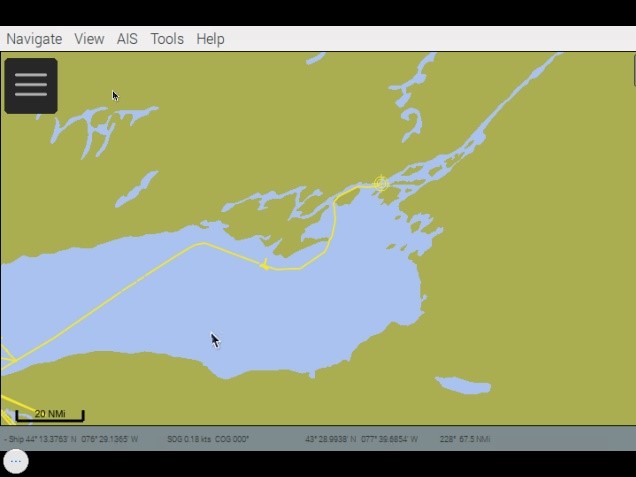
    When we looked at the track the next day, It’s clear where the meeting happened.  The laker must have been off the usual navigation channels, perhaps on her way to Cobourg industries.