Category: Navigation

  • Planning the Atlantic Crossing in 2024

    Planning the Atlantic Crossing in 2024

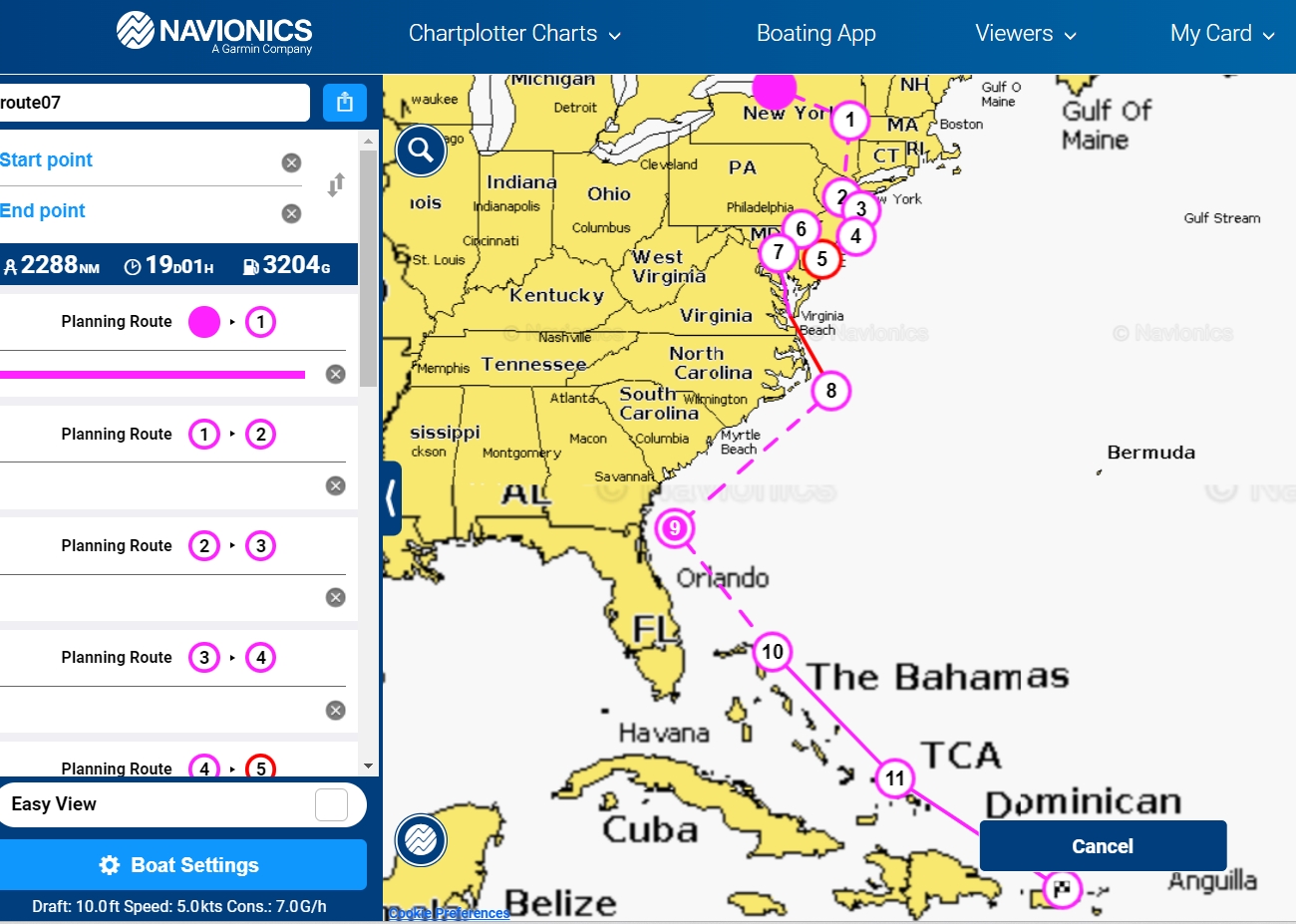
    We are about 50 days away from leaving Lake Ontario and heading south to the Caribbean and I started to do some long term planning using Predictwind, a web application that tells us which way the wind blows around the world.

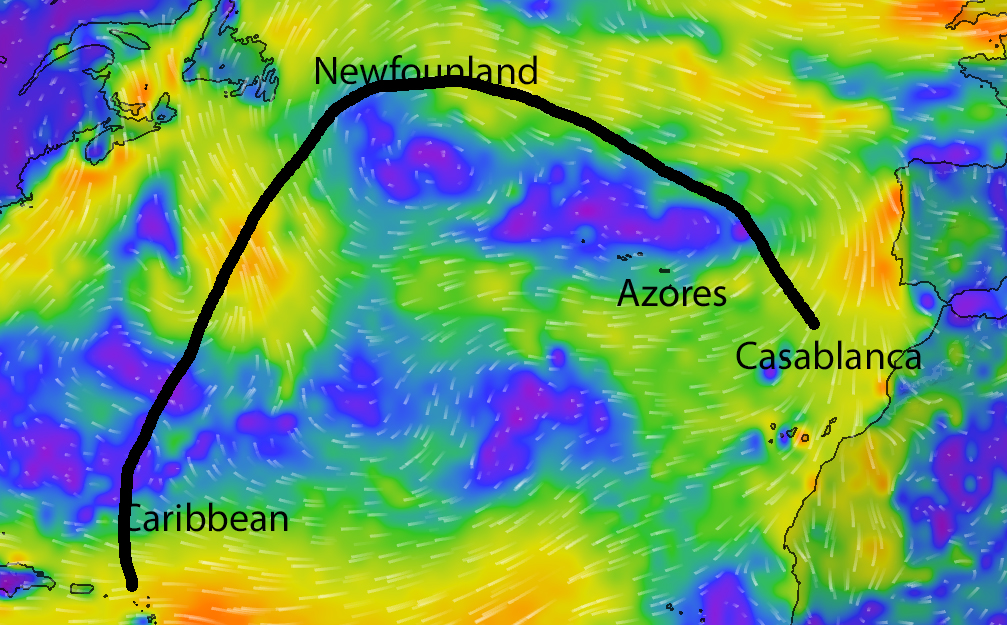
    I wanted to get a feel for what the wind in the Atlantic is doing this time of year, because this time next year we will be crossing the Atlantic. We’d start the crossing in about May before hurricane season The course will be from the British Virgin Islands area and head for the Azores, and then to Casablanca, in Northern Africa.

    Cruisers like to go mostly downwind and Predictwind tells us which way the wind is blowing now, and where it is likely to be blowing in in the near future. But as an example, we could head east today and in 5 days find out that the wind has changed and is now blowing to the west, directly in front of us, and all our weather planning would have to change and we might have to divert hundreds of miles.

    If a boat can average 6 knots per hour, and we are sailing 24 hours per day, we could average 144 miles per day in ideal conditions. We have to know where the wind is blowing now, and where it will be blowing in the near future and adjust our course like magicians or we could add days to the trip.

    Today’s weathermap isn’t very encouraging. The Azores High, which circles clockwise around the centre of the Atlantic Ocean has moved very far north. If we followed the black line downwind and the High didn’t change, then the trip becomes almost 4,000 nautical miles, or about 40 days of passagemaking. That takes us too far north and will take too long, I think. It should be about 12 days from the Caribbean to the Azores and another 7 days from the Azores to North Africa.

    There are many professionals who use worldwide data and predict where the wind and weather will change over a short period of time. Savvy sailors receive updates and guidance every day from these weather services. This allows them to adjust their direction to the safest and most efficient course. But in the end, each skipper must take all the information they have at the time to make safe and efficient decisions.
  • Recruits to Able Seamen.

    Recruits to Able Seamen.

    I’ve been giving this a lot of thought. And it is a huge leap from a raw sailing enthusiast to competent sailor and includes a lot of sailing time. So I asked my new friend ChatGPT what the steps are to train someone. Here is the question and answer. It’s a pretty good one but doesn’t include the ‘ice time’ factor that everyone needs.

    “How do i train someone with absolutely no experience in sailing to become an offshore crew?”

    Training someone with no experience in sailing to become an offshore crew member requires a structured approach and a combination of theoretical knowledge and practical skills development. Here are the steps you can follow:

    1. Start with theoretical knowledge:
      • Basic sailing terminology: Teach them the names of different parts of a sailboat, basic sailing maneuvers, and navigation terms.
      • Weather and sea conditions: Explain the impact of weather and sea conditions on sailing and offshore operations.
      • Safety procedures: Educate them about safety measures, emergency protocols, and the proper use of safety equipment.
    2. Enroll them in a sailing course:
      • Look for sailing schools or training centers that offer comprehensive courses for beginners.
      • Choose a course that covers the basics of sailing, navigation, safety, and seamanship.
      • Ensure the course includes practical sessions on different types of boats and various sea conditions.
    3. Practical training:
      • Provide hands-on experience on a sailboat under the guidance of an experienced sailor or instructor.
      • Teach them basic boat handling skills, such as steering, hoisting sails, trimming sails, and docking.
      • Familiarize them with different types of sails, rigging, and deck equipment.
      • Practice various maneuvers, including tacking, gybing, and reefing.
    4. Navigation and seamanship skills:
      • Teach them how to read nautical charts, plot a course, and use basic navigational instruments like a compass and GPS.
      • Introduce them to the International Regulations for Preventing Collisions at Sea (COLREGS) and other relevant maritime rules.
      • Emphasize the importance of maintaining a lookout and understanding navigational aids.
    5. Safety training:
      • Train them in basic first aid and CPR.
      • Teach them how to handle emergency situations, such as man overboard, fire, or equipment failure.
      • Make sure they know how to use safety equipment, including life jackets, flares, and emergency signaling devices.
    6. Experience and mentorship:
      • Provide opportunities for the trainee to gain practical experience by crewing on sailboats in different conditions.
      • Encourage them to participate in races, regattas, or offshore passages to gain confidence and enhance their skills.
      • Pair them with experienced sailors or mentors who can provide guidance and support.
    7. Continued learning:
      • Encourage the trainee to continue learning and advancing their skills through additional courses, workshops, or sailing certifications.
      • Suggest books, online resources, and sailing communities where they can expand their knowledge.

    Remember, becoming a competent offshore crew member takes time, practice, and experience. It’s crucial to prioritize safety throughout the training process and ensure the trainee gains confidence and proficiency in various sailing techniques before venturing into offshore environments.

  • Cambio’s Tentative Trip South Fall 2023

    Cambio’s Tentative Trip South Fall 2023

    I’ve posted on the Fall/Winter plans before, and I’ll probably do it again as we learn more and more about the routing from Lake Ontario to Puerto Rico. 

    Why Lake Ontario?  Because that’s where we are now.  

    Why Puerto Rico?  Because it is a convenient are to do some R&R after a trip of more than 2150 nautical miles.  

    R&R isn’t crucial because we are taking our time to get there.   Critical dates include

    September 1      Leave Oswego in the Erie Canal

    October 12         Annapolis Boat Show

    October 16         Leave for the south.  Use the ICW sparingly and when out in the Atlantic, avoid Hattaras near Pamlico Sound and Frying Pan Shoals near Wilmington.

    November 1       Arrive at St. Augustine.

    November 5       Arrive at Bahamas.   Play in the sand for a while.   

    December 1       It is still 1000 nm to Puerto Rico.  (See the “Thorny Path”   At 100nm per day that’s 10 days non stop.   There will be stops along the way; Crooked Island, Mayaguana, Turks & Caicos, Puerto Rico.  That last leg is a long stretch, probably upwind, but my insurance company doesn’t want me to go to Dominican Republic.  I’m going to have to negotiate with them. 

    And if we get there for January 1, a month later, it means we had a great time. 

    Until sometime In May we’ll visit the lesser Antilles, which include all the Virgin Islands, Monserrat, St. Martin, the Islands in between.  Plans to be devised. 

    Now pay attention.  This will probably change as we get closer to planning.  

  • It was really dark

    It was really dark

    It was really dark.

    Our darkness happened at night, sailing down the middle of the lake, with clouds obscuring the lights of the towns along both shores, and nobody else on the lake.   

    Even the spreader lights did the deck no justice but they did highlight the foam close to the boat that lit up on the top of the 3 meter waves we were surfing down.

    It was really dark

    Ahead of us, and far away a single red light and two white lights appeared off our starboard bow.   It started a conversation with my crew, Matt.   We decided it was a later about 5 miles away.  After discussion, Matt figured out that if we could see the red light, it must be going across our bow and we should watch it carefully.   Besides the waves and the compass, this was the most interesting thing to watch. 

    We were on a course of about 63 degrees.  We had left Port Dalhousie about 9 hours ago.  Lakers tend to go down the middle of the lake in ‘laker lanes’  unless they are turning left or right to visit an industrial dock or turn into the Welland Canal. 

    Almost nothing in this paragraph makes sense.  As the lights got closer we started to believe that we were on a collision course.  I turned off the autopilot and steered to starboard.  After a couple of minutes of hand steering, the compass told me I had strayed from 63 degrees and was now on 315 degrees.  I used the autopilot to steer back to 63 degrees.  It was not certain that we were on a collision course, but we were keenly aware of the 3 lights which were all we could see on a laker that was otherwise painted black.   I hand steered again.   I watched the lights.   I checked the compass.  We were far off course again.  I repeated this a few times. It was difficult to hand steer in jet black!

    Suddenly we could hear the rumble of the laker.   It was about 200 meters from us, and definitely on a collision course.   I turned to starboard with caring what the course was.   The laker had its own bow wave and it was white.  We looked up at the laker’s gunwales as we passed the hull, 50 to 100 meters away.   The laker’s wake bounced us about as it passed.   My adrenaline was at a high.  But we had avoided the collision.  

    There were two boats in the lake and we found each other.

    Lessons learned.

    • We were on Starboard. It makes no sense to claim rights.  He had gross tonnage rights.  And we would never have claimed the right of way.  That would be reckless in this case, and stupid. There are other reasons this decision was correct, like my inability to hold a course, but it’s all moot.
    • I wonder if there is a ‘firefly’ effect where we are drawn to lights in the pitch dark as a part of nature.  I don’t know, but if the situation comes up again, I’ll be aware.
    • Our watchkeeping was correct.  We picked it up miles away and watched it constantly until the near miss.  
    • Our teamwork was great.  We discussed options and perspectives constantly until the near miss.
    • My hand steering was inadequate.  Period.

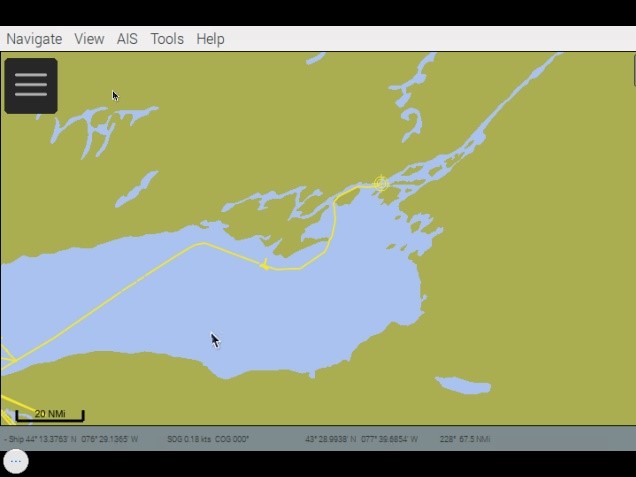
    When we looked at the track the next day, It’s clear where the meeting happened.  The laker must have been off the usual navigation channels, perhaps on her way to Cobourg industries.  

  • Leaving Brighton, I paid very close attention to Ray, and kept to the narrow track

    Leaving Brighton, I paid very close attention to Ray, and kept to the narrow track

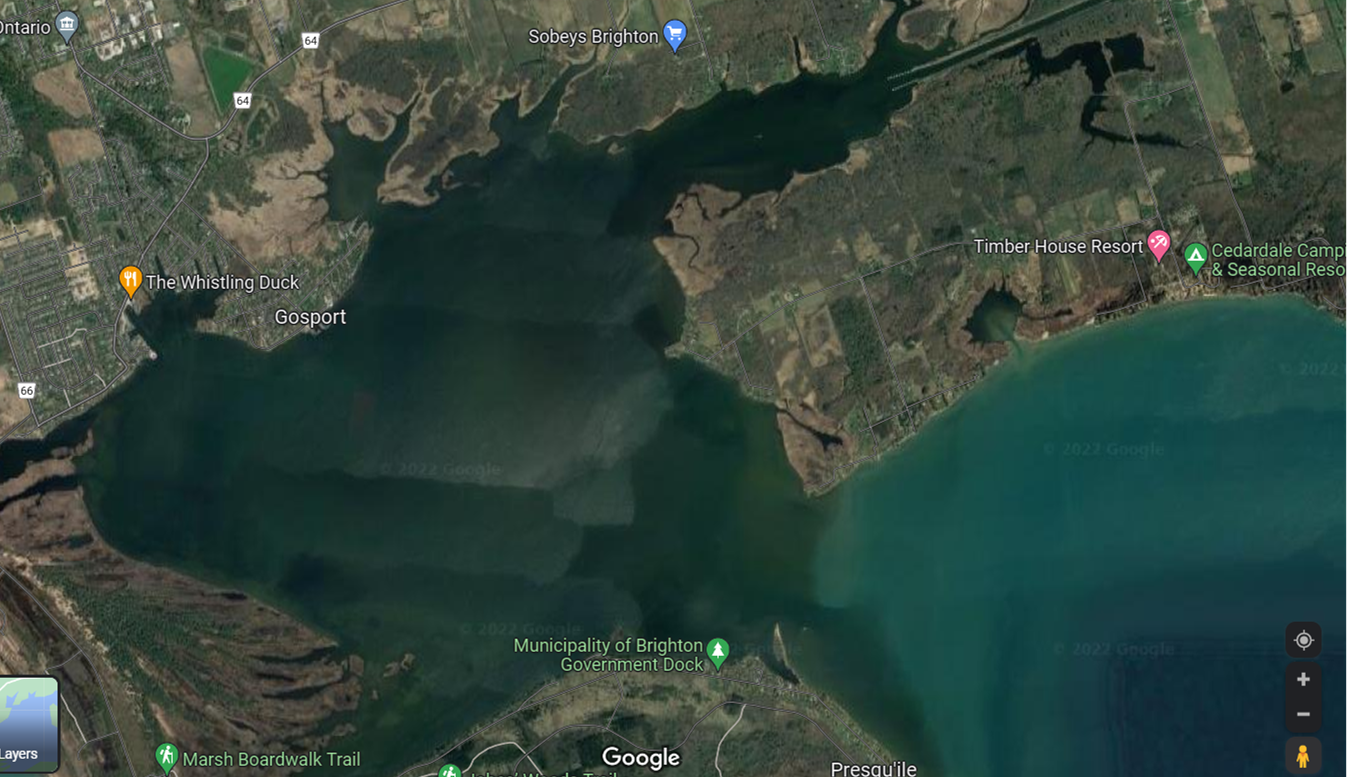
    Leaving Brighton, I paid very close attention to Ray, and kept to the narrow track based on a combination of depth reports on the Raymarine plotter and the navigation buoys.   After the collision yesterday it was a nailbiter but I didn’t hit the ground at all.

    There is a government dock at the end of the canal that has bollards or cleats attached to massive concrete blocks.  All three of us boats in our tiny flotilla stopped there for the night.  The other two boat crews went to the motor racetrack which is about a 200 meter dinghy ride followed by almost a kilometer walk through the bush.  

    Pierre and I did not go to the races.  We made dinner and played Rummy, and before we turned in for the night, I turned the anchor and spreader lights on in case the kids were late and lost in the pitch dark.  They didn’t mention that they got lost, but they did acknowledge that the lights were a help.     

    Just before Presqu’ile Point my Raymarine plotter went wonky and displayed a test pattern of drivel.  (We called the Raymarine, “Ray” and the Autopilot, “Otto” so Ray and Otto guided us most of the time.)

    I turned it off and on many times and pulled out my phone to message my brother who is a guru when it comes to such things.   He messaged me back a few minutes later.  I had already pulled up Navionics on the phone and would have done just fine without Ray.  His advice was “wiggle the wires in back of Ray”.   I did this and Ray was fixed, in time to show me that I should go way out into the lake before turning right towards Cobourg.   

    It was a relatively easy upwind motor to Cobourg.  

  • I’ve Grounded Too Often

    I’ve Grounded Too Often

    Saturday August 27, 2022, Belleville to Murray Canal

    The convoy of 3 boats left Belleville with the intention of going through the Murray Canal.   The Murray canal has very narrow entrances, with shallow areas on each side of the ‘ditch’ under water.  In one area there is a shallow 3 feet on the north side and less than 6 feet on the other side.  The available width is just 60 feet or less. 

    We were told by the swing bridge crew to hold position in this underwater canyon.   I started getting close to the less than 6 feet north side and tried to turn around in narrow space.  I hit Doug’s dinghy, and broke a couple of expensive fittings.  He yelled at me to reverse and I tried, but failed to do so in time and ultimately hit his boat.   I’m very angry at myself for being intimidated by the shallow water and screwing up Doug’s day.    It was completely my fault and it haunts me even when I write this a week later.  He got a quote for the broken pieces and I reimbursed him immediately, but it was a pittance for my ruining both our days.  I was so shaken I got grounded on the south side and plowed through soft mud that was about 5.5 feet deep (I draw 6 feet).  We left 30 foot trail of muddy water behind us before we got clear.    I’ve grounded too often lately and I still have to go through the dreaded Presqu’iIe Bay tomorrow where the navigation buoys don’t necessarily keep you from running aground. 

    It is at the second swing bridge that boats must pay $5.50 for passage through the Murray Canal.  As you approach the open bridge, a person passes a long stick with a bucket on the end and boaters are supposed to drop the money into the bucket as payment.   It is a quaint custom, but it is their way and it works, I guess.  Pierre dropped the money in and we passed through.

  • The tow line was caught tight in the propellor

    The tow line was caught tight in the propellor

    Tuesday August 23, 2022, Waupoos

    Geezus I thought the boat was in perfect condition, but I seem to have spent the day screwing it  up all by myself.  I did non of the 3 things I meant to do today that I listed yesterday. 

    Pierre and I motored from Kingston Yacht Club in a very heavy rainstorm that had no thunder or lightening.  It was wet in every crack of the boat and every crack of the two of us.   But it was exhilarating, even so.  The weather lightened up at 1pm and we arrived at Waupoos Winery at about 3:30.  

    My contact at the winery said to anchor about 50 feet off the dock.  I saw a big white building and thought it was Waupoos Winery.   It wasn’t.  It was about a half km east of the winery but we hadn’t figured that out. 

    The chart said 12 feet, and I draw 6 so of course I ran aground in the sand.  My first grounding, albeit a soft one. The depth meter said 5.9 feet and we were going very slowly so there was only a slight change in velocity.   No problem.  I’ll just back up.  

    So I did.

    I had forgotten that the dinghy was being towed behind me.  I ran it over.  It ended up wrapped around the bow.   The dinghy brand spanking new tow line caught the brand spanking new propellor and the engine died.  I ran forward and dropped the anchor.  It worked wonderfully.

    The tow line was caught tight in the propellor, even though it has a cutter, and was attached fast so I couldn’t pull it out.  

    Oh well.  We have to clear the dinghy and put the motor on anyway to go visit the winery. 

    There is a design flaw on the block and tackle mechanism that raises and lowers the dinghy motor from its perch to the back of the dinghy.    A cleat is up top that is practically unusable.  We had to take the cleat out of the equation and lower the motor onto the dinghy.  I’ll move the cleat down someday but until then it really can’t be used easily.  

    By the time we had dinghy and motor in place it was too late to dive on the propellor and cut the line away.  So I’ll do that tomorrow morning.  The flaw in that thinking is that if I end up on a lee shore in a blow tonight, I’ll be up the creek with no motor.   All I can do is sleep lightly and well and do the dive early. Stay tuned.  This was poor foresight on my part.

    We got to the winery, got a tour, and a tasting, bought a couple bottles of wine…yadda yadda  Actually Waupoos Winery has a whole farm to table program with cattle, pig, sheep, and other food animal farms.  They feed the leftover grapes, apples, peanuts, hazelnuts, and other leftovers from their processes to the animals, which you can dine on at the restaurant.  It is one of the most complex and well thought out farm to table programs and it is clear that they are very proud of the program.   I hope that it is sustainable.

    Tomorrow it is:

    • Dive on the propellor
    • Breakfast
    • Motor to Deseronto and decide whether to try for Belleville or not.
    • Do one of the three things I didn’t do today. 

    Long day.

    Oh yea.  As I open the coach hatches the pain in my shoulders reminds me of the goddam dinghy motor that wouldn’t start.  It’s only been run one time before and I am not fucking impressed.  It should have started on the first pull, not after many that gives me bruises and strained muscles.  I wanna scream at the salesman because that’s all I know.  It’s a..  aw sheet, I forget.