Author: admin

  • Model Shoots Coming UP!!

    Model Shoots Coming UP!!

    I am inspired to write tonight but don’t seem to have inspiring things to write. lets see if that changes

    I bent on the main today. I was about to slip it into the boom track and then realized that I had forgotten it was a loose footed main. Doh!

    Since the double knee replacement 9 weeks ago, my knees have improved, but they are still a worry. I worry that I’ll jump down into the cockpit and it will hurt a lot. In reality it only hurts somewhat but I know it is gonna hurt and the it has me walking like a tenderfoot all around the deck. I think it will be another 8 weeks or so before I’m anything more than the fat boy at the wheel. Except..

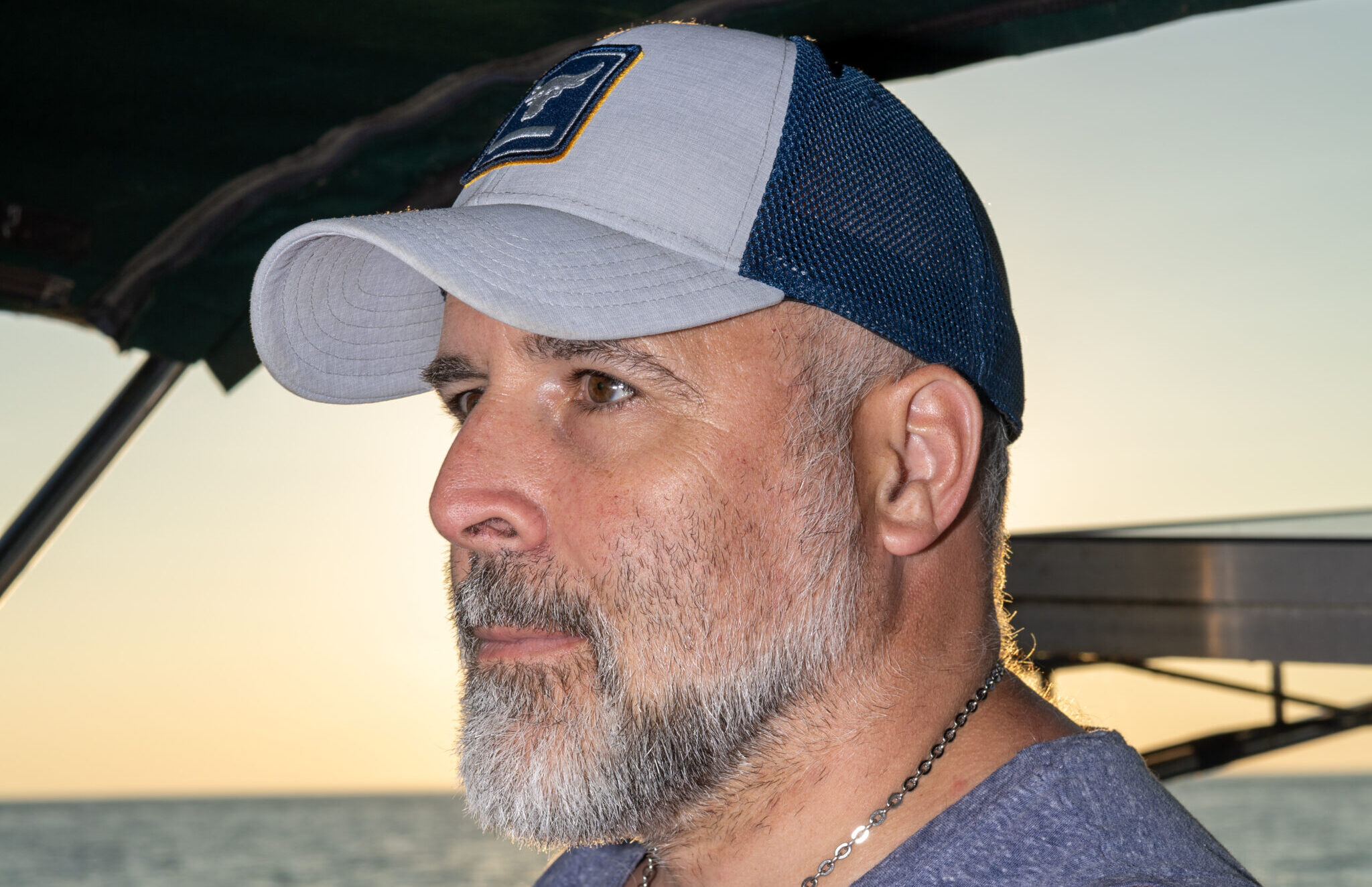
    This week I’m starting to promote some glamour photography on the boat. By June the temperatures will be wonderful and I’ll take glamourous models and fit athletes for a sunset sail and photograph them on the boat. I did it last year and the models were thrilled with the pictures and the pics turned out stunning. Stay tuned for some of the pics to be posted here. Or look back at last year’s images in this log.

    That is all for tonight. I guess I found something cool to talk about anyway!! Have a great night !!

  • Natty Genco Canvas Boat Cover for Sale

    Natty Genco Canvas Boat Cover for Sale

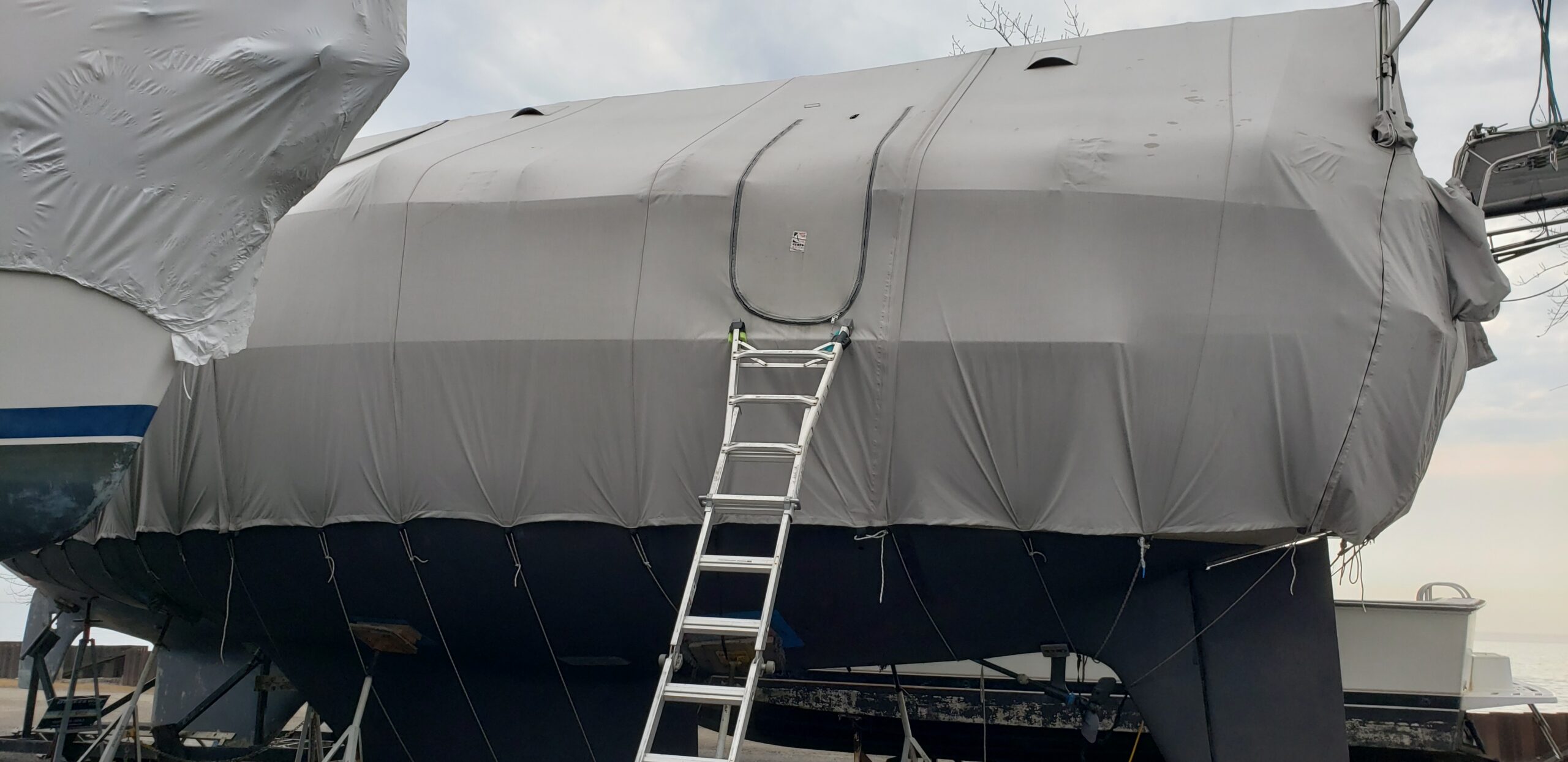
    As we get ready to go south, we won’t be needing the boat cover and we are offering the Genco canvas cover for sale. We just won’t need it for a few years.

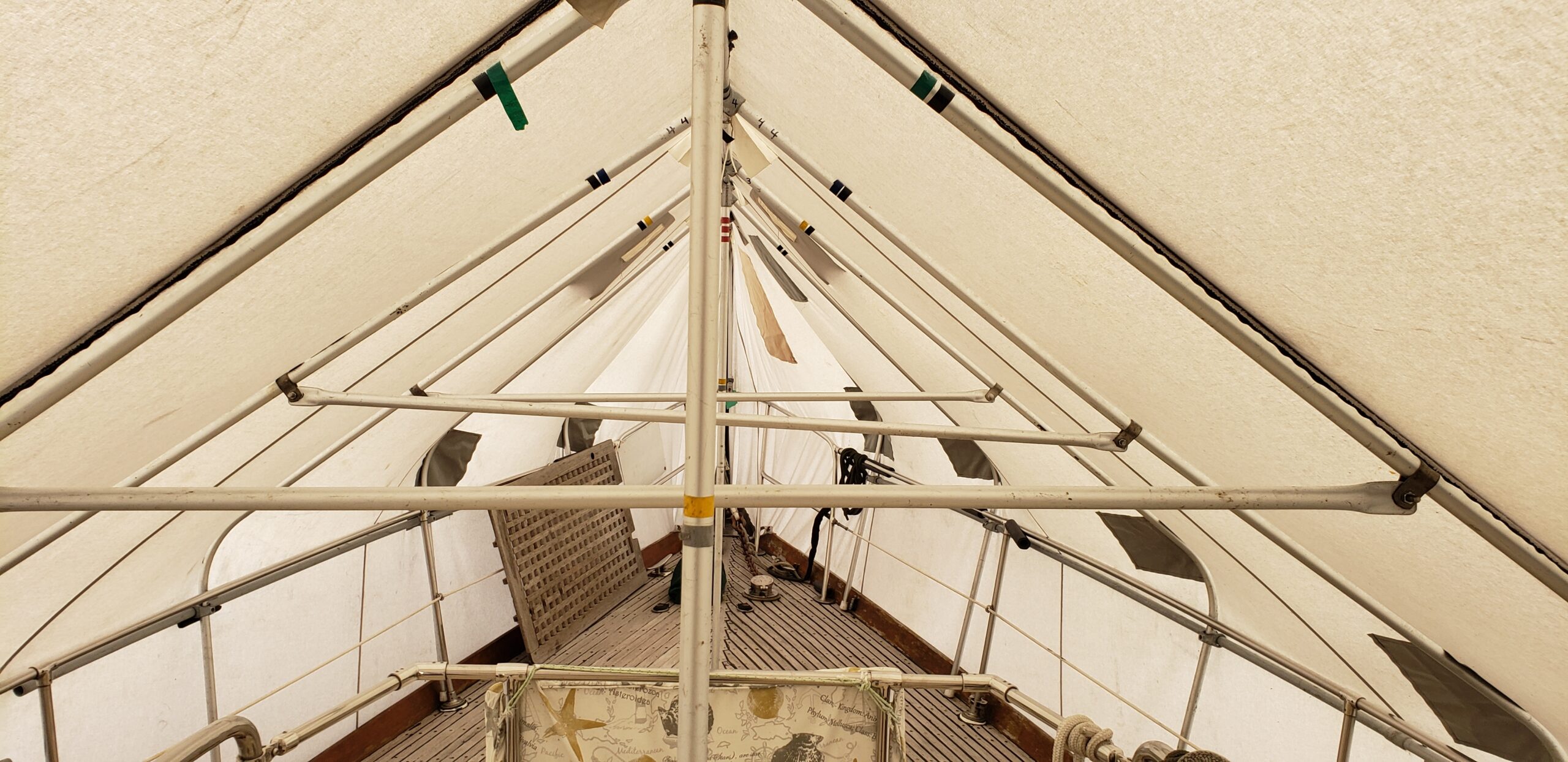
    It comes with an aluminum frame and completely covers the gelocoat topsides. It is available in St. Catharines, Ontario. It is in great shape.

    I called Genco, who made it originally. They quoted me just over $7000 for the new boat cover for the 41′ Cheoy Lee Pedrick fiberglass boat.

    I’m asking half price, $3500. It is in great shape and covered the boat last year perfectly.

    Please Call 905 321 2291 to inquire.

  • Announcing Chef Lori Ryan as Cambio’s Executive Chef.

    Announcing Chef Lori Ryan as Cambio’s Executive Chef.

    It’s not every 41’ sailing yacht that has it’s own private chef, but after a few samples which just made my taste buds gasp, I’m proud to announce that Chef Lori Ryan is joining the Cambio roster as executive chef for Cambio.  

    We have no plans to run a restaurant on the boat.  We are just thrilled to announce Chef Ryan as our official executive chef. 

    Her cuisine features fresh herbs, interesting mixes and exotic mains, all surprising and fabulous.  Stay tuned throughout the season as we trot out menus and images of what a “proper yacht” can be counted on for fantastic food. 

    Lori Ryan is Niagara based and can be contacted at 289-214-1651.

  • From Cold Sweat to Adventure: How Filling Out a CPP Form Changed My Life

    From Cold Sweat to Adventure: How Filling Out a CPP Form Changed My Life

    I was sitting at my desk filling out my Canada Pension (CPP) Form.  The form has an area at the top for personal information and a bit more.  It has a big area of small text that I’m sure very few people read.  At the bottom there is a place for a signature and date. 

    I filled out the top, skipped over the middle, and hovered my pen on the signature place at the bottom. 

    Now signatures are permanent where the government is concerned, but that wasn’t really what brought out a cold sweat on me.  

    My first thought was a loud (in my head), “Is that all there is?”   followed by that cold sweat.   I was not liking what I was doing because it occurred to me that I had no long term plan.   

    A few days later the same feeling hit me but this time there was a cold sweat followed by a “F*ck NO!  I still have one more ride in me!  Maybe two or three!”  Self-talk can be powerful when it is piled on with “positive self-talk”

    I began to realize that I had loved competitive and cruising sailing for the last 30 years.   I had loved photography for the last 10 years.  I loved traveling.  I loved taking on new and difficult tasks.    

    It took a month or so to study what was involved in getting a boat again, going for a long sail, and basically doing one more startup with a crew, a goal and all the business stuff like budgets, timelines, and the dreaded critical breakdown structures.    

    Out of this horrible realization, followed by a pile of constructive thought process, and research came my next step, which was post CPP.   

    That’s how Sailing Cambio was born two and a half years ago.    I’ve now bought the boat, spent a summer season getting practical cruising experience on a new boat.  I’ve mapped out where I want to sail to.   I’ve given some deep thought on what kind of photography I want to do, and to end up doing something that I’ve never done before.   

    All due to the cold sweat of a significant signature on a CPP form. 

    And that is why I’m bringing the boat up to near mechanical ‘perfection’; began recruiting sailors with adventure in their souls; spent two winters mapping out cruising waters and learning all I can from YouTube, reading, talks with experts and by doing.

    The adventure started 2 and a half years ago and the next step is preparing the boat for launch in a few days, then cleaning, maintenance, and sea trials which will start a second season of big boat cruising experience on Lake Ontario. 

    Then September 1 or so the boat and crew leaves for the Caribbean to start the adventure. 

    All because I was shook up by the very officious signature.   It didn’t turn out so badly after all. 

  • 2023 Splash Prep, Christmas in the cradle, and Cover for Sale

    2023 Splash Prep, Christmas in the cradle, and Cover for Sale

    Cambio is arranged to splash April 24, which is pretty early but I can’t wait for the season to start.   

    I’ve got a half a list that contains the things that must be done before the boat goes in the water.  They, of course are priorities.     Then there’s the longer list of things that can be done after the boat goes in the water.   They are less priorities, but I have longer time to do them.  This means that the priorities on the post splash list tend to be a bit looser, and every day I add more to the post splash list. 

    Both my knees are complaining about the knee replacements 8 weeks ago and they are complaining loudly.  I can climb the 12 foot ladder but I’m not so steady coming down and I don’t want to be working there alone yet.  So the village has come together to help me out and I’m very thankful.

    Thanks to Tyler, Fred, Sam and Rob, who got the Genco cover off yesterday.  Today Henri did most of the puzzle solving by putting the bimini together.   Keith has fixed the ladder so that it drops further into the water, making it easier for crew to get out of the water.  Keven is replacing some halyards and making  up some other lines that are needed for replacement.

    When the boat is coming out in the fall, enthusiasm has waned with the approaching winter and boat putaway is somewhat sloppy.  But when spring is approaching and after that a fantastic sailing season to be followed by a fabulous adventure in the Caribbean, there is no waning, just raining, as we get the boat back into Bristol Shape. 

    And it was a bit like Christmas today.   I’ve been hunting through returns centres and salvage places looking for stuff for the boat at cheap prices.  Some of these I wouldn’t buy if they were close to regular prices, but the deals have been too good to pass up.    I got a set of walkie talkies for 5 bucks.  The second set was 3 bucks.  The moisture meter was just 5 bucks.  A 30 litre waterproof bag was just 5 bucks.  And so on.  I brought the first pack to the boat today.  I had forgotten all the great items I’d gotten and it was like Christmas opening them up, and then a bother trying to find the right space to store them in.   It will all work out.

    Speaking of the Genco cover, it is for sale.   I’m not going to need it for the next 3 years at least so it is a fine tarp cover with frame for a 41’ boat available for pickup in Niagara, Canada.   I also have adjustable stands (7) to support Cambio for sale.  Inquire anytime. 

    /

  • Cambio’s Tentative Trip South Fall 2023

    Cambio’s Tentative Trip South Fall 2023

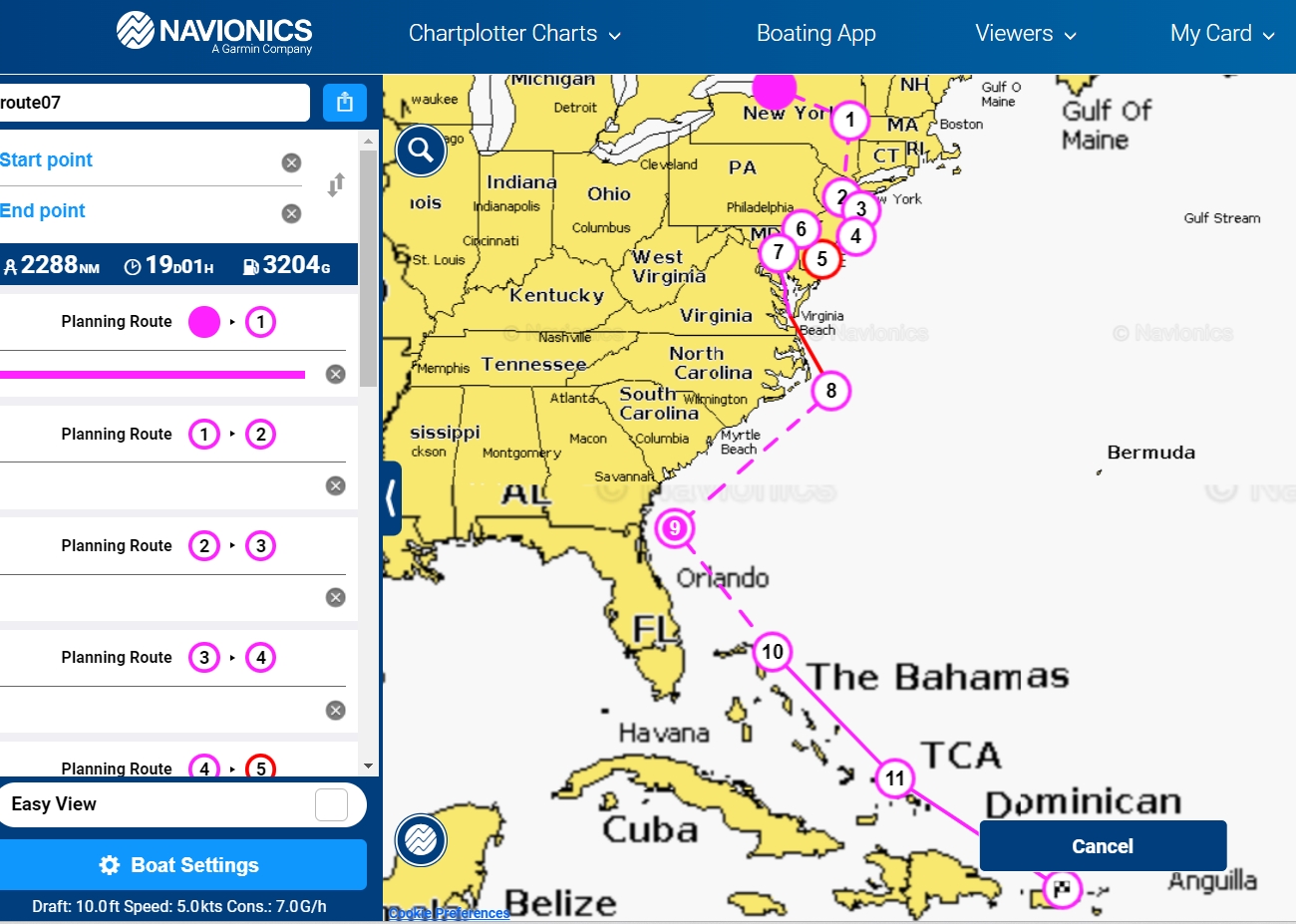
    I’ve posted on the Fall/Winter plans before, and I’ll probably do it again as we learn more and more about the routing from Lake Ontario to Puerto Rico. 

    Why Lake Ontario?  Because that’s where we are now.  

    Why Puerto Rico?  Because it is a convenient are to do some R&R after a trip of more than 2150 nautical miles.  

    R&R isn’t crucial because we are taking our time to get there.   Critical dates include

    September 1      Leave Oswego in the Erie Canal

    October 12         Annapolis Boat Show

    October 16         Leave for the south.  Use the ICW sparingly and when out in the Atlantic, avoid Hattaras near Pamlico Sound and Frying Pan Shoals near Wilmington.

    November 1       Arrive at St. Augustine.

    November 5       Arrive at Bahamas.   Play in the sand for a while.   

    December 1       It is still 1000 nm to Puerto Rico.  (See the “Thorny Path”   At 100nm per day that’s 10 days non stop.   There will be stops along the way; Crooked Island, Mayaguana, Turks & Caicos, Puerto Rico.  That last leg is a long stretch, probably upwind, but my insurance company doesn’t want me to go to Dominican Republic.  I’m going to have to negotiate with them. 

    And if we get there for January 1, a month later, it means we had a great time. 

    Until sometime In May we’ll visit the lesser Antilles, which include all the Virgin Islands, Monserrat, St. Martin, the Islands in between.  Plans to be devised. 

    Now pay attention.  This will probably change as we get closer to planning.  

  • Boat maintenance: the 55-point skipper’s checklist

    Boat maintenance: the 55-point skipper’s checklist

    • Katy Stickland compiled this list for Yachting Monthly magazine and it is a great checklist for spring. I’ve posted it here so that I can find it in 2 weeks when I commission Cambio, and for next year when I do it all over again.
    • If it helps you, send Katy a note. Authors of good articles love to hear that stuff.

    The ultimate boat maintenance checklist to make sure your yacht is ready for launch and the start of the sailing season

    Check your rudder for hairline cracks or damage

    Boat maintenance: the 55-point skipper’s checklist

    Boat maintenance: Mast & Rigging

    Check all your standing rigging connections. Credit: Colin Work

    • The mast cap is out of sight, out of mind 99% of the time, but serves multiple functions: backstay, forestay, cap shrouds, radio antenna, nav lights, halyard sheaves. Rotate mast and boom sheaves to check they are not misaligned or worn by a bad halyard lead. Lubricate sheaves with WD40 or silicone grease.
    • Spreaders, gooseneck, mast heel, kicker, mainsheet and topping lift connections all need checking for wear, damage or corrosion.
    • Check for galvanic corrosion between different metals.
    • Check electrical connections, deck and spreader lights.
    • Wax mast tracks and luff grooves with candle wax or Teflon spray.
    • Standing rigging: Look for areas of wear or stranding on the wire. Check mast tangs, T-ball joints and rigging screws.
    • Wash furling drum and swivel and check they move freely. It’s common for the top swivels to become stiff and sometimes seize, which can compromise the forestay wire.
    • Running rigging: check for chafe and that the shackles aren’t seized. Sheets, halyards, warps: wash in fresh water to get rid of salt and grime.

    On Deck

    Below Deck

    Head, bilge & gas

    Check bilge pumps it might sound ok but is it actually attached to a hose?

    • Check impeller on bilge pumps and grease with water pump grease only (Vaseline will rot impellers)
    • If you have an automatic bilge pump, check float switches work.
    • Dry bilges thoroughly then if water appears after relaunch you’ll know you’ve got a leak.
    • Fill water tank and add purifier such as Puriclean or Milton
    • If the pump on the heads is stiff look to service and lubricate with silicon grease.
    • If you have a gas sensor, check it works.

    Boat maintenance: Below waterline

    Hull and skin fittings

    Check jubilee clips for rust. Credit: Bob Aylott

    • Most vessels have DZR (dezincification-resistant brass) seacocks. Look for any signs of corrosion on the skin and tail joints, which are common points of failure.
    • Ensure all valves are greased.
    • All hoses should be double-clipped. Check jubilee clips for rust. Do you have wooden plugs attached in case of emergency?
    • Check skin fittings are free of blockages/ growth or antifouling.
    • Check anodes have plenty of life. Don’t forget prop shaft and saildrive anodes.

    Rudder

    • Check leading, trailing and lower sections for damage or hairline cracks.
    • Check for play in bearings, stock or quadrant. Movement should be minimal. Grease steering cable.

    Keel

    • Check for stress cracks or movement internally and externally – especially at the keel root and around the internal framing or matrix, and around fastenings and backing washers.

    Prop shaft & stern gland

    • To check bearings, grasp prop in both hands and try moving it up and down and from side to side. There should be little, if any, movement – no more than 2mm.
    • Check P-bracket for stress cracking from misalignment or damage.
    • Stern gland packing. Many yachts have some form of deep-seal arrangement that has a service life of around seven years. Those that have a proper stuffing gland will need to be greased to prevent drying out and getting brittle. The gland may need pulling down or repacking at some point.
    • If you have a saildrive, check the condition of the seal and the metal ring that holds it in position. Again, note the seals have a life expectancy of between five and seven years depending
      on manufacture.

    Boat maintenance: Mechanics

    Engine

    Check all filters

    • If you didn’t change the oil when you laid up, change it now.
    • Change fuel filters.
    • Remove rags stuffed in outlet pipes from winterisation.
    • Impellers – if removed at lay-up – reinstall with a smear of water pump grease.
    • Reinstall the engine belts and check tension: there should be no more than half an inch of play.

    Saildrives

    • Check oil levels. Check durability of the gaiter seal. Check rubber faring and reseal if necessary.
    • Change internal engine anode.
    • Check engine mount is secure.
    • Check diesel tank for water from condensation. Drain off or replace fuel. Add an appropriate biocide to help kill off diesel bug.
    • Check inaccessible wiring, such as bonding wires from the anode and earthing wires from the starter motor. Clean the terminals and smear them with Vaseline or silicone gel.

    Batteries and electrical systems

    • Check electrolyte level if yours is an open lead acid battery; tighten battery securing straps and make sure vent for gases is clear. Clean terminals and coat with Vaseline. For sealed batteries, check the condition of indicator light, or other charge indicator.
    • Switch on instruments and use backlighting to help reduce any condensation.
    • If the anode looks serviceable for another season, check bonding and wires. If they haven’t worn at all they may not be working so check Ohm resistance max 0.2 from propeller to anode.

    Sails

    • Check for chafe, wayward stitching and tears. Do you carry a sail repair kit?
    • Take to a sailmaker if the sacrificial strips is worn out.

    Charts

    Make sure your navigation apps are up to date

    • Update charts from Notice to Mariners.
    • For electronic charts, check with your supplier how to update. New chartplotters can connect to WiFi, or you may need to connect the chart chip to your PC at home and download the update.
    • Download operating software updates for your chartplotter and instruments.
    • Make sure your subscriptions for navigation apps on phone and tablets are up to date with the latest charts.

    Safety

    Gas system

    • Check age of hoses. If they are over five years old, they should be replaced. Check for kinking or wear in gas hosepipes. If in doubt, replace.
    • Check hose clips are tight. Hoses behind cookers should be armoured.
    • Check thermal cut outs on hob, grill and oven work.

    Harness/lifelines

    • Check stitching and get repairs done by a sailmaker if necessary.
    • Jackstay and Danbuoy lines: check condition and points of security.

    MOB lights

    • If you have the traditional type, check the bulb, battery and that it actually works. The new types have various ways of testing, and all have an expiry date.

    Lifejackets

    Is your lifejacket fit for purpose and in good condition? Credit: Theo Stocker

    Stanchions/lifelines

    • Check stanchions and make sure lifelines are still suitably secured at each end and cords and pins are in good order.
    • Watch out for wire failing if you have plastic sheathing.

    Flares

    • Make sure these are in date, in a watertight container and are easy to reach. It’s worth having gloves and goggles to hand too.

    EPIRBS

    • Make sure these are in date and registered with the correct contact details.

    Liferaft

    • Ensure this and the hydrostastic release are within the service date, and you are aware of its contents.
    • If its secured with a rope, consider if you could release it in an emergency with ease.
    • Make a grab bag up with essentials
  • It was really dark

    It was really dark

    It was really dark.

    Our darkness happened at night, sailing down the middle of the lake, with clouds obscuring the lights of the towns along both shores, and nobody else on the lake.   

    Even the spreader lights did the deck no justice but they did highlight the foam close to the boat that lit up on the top of the 3 meter waves we were surfing down.

    It was really dark

    Ahead of us, and far away a single red light and two white lights appeared off our starboard bow.   It started a conversation with my crew, Matt.   We decided it was a later about 5 miles away.  After discussion, Matt figured out that if we could see the red light, it must be going across our bow and we should watch it carefully.   Besides the waves and the compass, this was the most interesting thing to watch. 

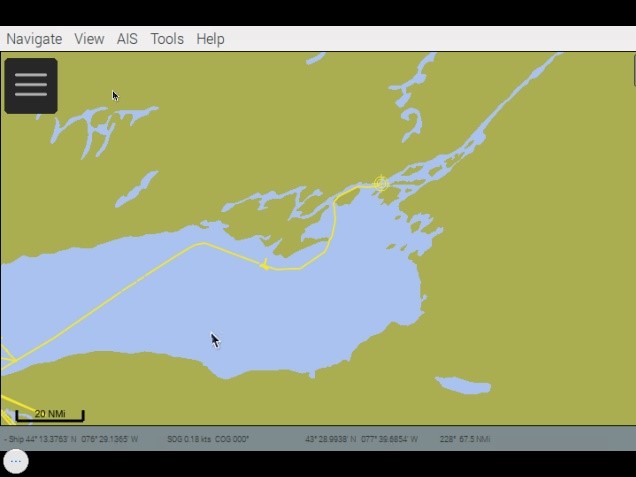
    We were on a course of about 63 degrees.  We had left Port Dalhousie about 9 hours ago.  Lakers tend to go down the middle of the lake in ‘laker lanes’  unless they are turning left or right to visit an industrial dock or turn into the Welland Canal. 

    Almost nothing in this paragraph makes sense.  As the lights got closer we started to believe that we were on a collision course.  I turned off the autopilot and steered to starboard.  After a couple of minutes of hand steering, the compass told me I had strayed from 63 degrees and was now on 315 degrees.  I used the autopilot to steer back to 63 degrees.  It was not certain that we were on a collision course, but we were keenly aware of the 3 lights which were all we could see on a laker that was otherwise painted black.   I hand steered again.   I watched the lights.   I checked the compass.  We were far off course again.  I repeated this a few times. It was difficult to hand steer in jet black!

    Suddenly we could hear the rumble of the laker.   It was about 200 meters from us, and definitely on a collision course.   I turned to starboard with caring what the course was.   The laker had its own bow wave and it was white.  We looked up at the laker’s gunwales as we passed the hull, 50 to 100 meters away.   The laker’s wake bounced us about as it passed.   My adrenaline was at a high.  But we had avoided the collision.  

    There were two boats in the lake and we found each other.

    Lessons learned.

    • We were on Starboard. It makes no sense to claim rights.  He had gross tonnage rights.  And we would never have claimed the right of way.  That would be reckless in this case, and stupid. There are other reasons this decision was correct, like my inability to hold a course, but it’s all moot.
    • I wonder if there is a ‘firefly’ effect where we are drawn to lights in the pitch dark as a part of nature.  I don’t know, but if the situation comes up again, I’ll be aware.
    • Our watchkeeping was correct.  We picked it up miles away and watched it constantly until the near miss.  
    • Our teamwork was great.  We discussed options and perspectives constantly until the near miss.
    • My hand steering was inadequate.  Period.

    When we looked at the track the next day, It’s clear where the meeting happened.  The laker must have been off the usual navigation channels, perhaps on her way to Cobourg industries.  

  • Cambio Named Storm Emergency Plan

    Cambio Named Storm Emergency Plan

    Cambio Named Storm Emergency Plan For Eastern Caribbean and USA

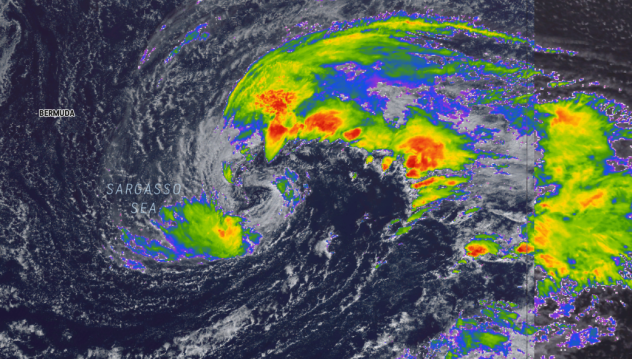
    Assuming that you can’t get out of the June to November hurricane season that makes the Caribbean dangerous, here are some thoughts about how to prepare for a bigger than normal storm.  This is not a primer, but it is a list of things to consider.  When the stuff hits the fan, it’s easier to use a checklist than remember everything all at once.   Remember that there are thousands or more boats in the Caribbean and most of them survive handily but some don’t, and we see those ones on television. 

    One more thing:   The crew are far more important than the boat.  Keep them safe.

    We are assuming anchoring out is not an attractive option, although many boats will be doing it. 

    Before and on threat of the Named Storm

    1. Watch the weather daily. 
    2. Use the Starlink wifi to check PredictWind and the NOAA weather forecast or the radio. 
    3. When a significant storm is brewing, increase the frequency watching the weather predictions
    4. When a possible storm is discovered, prepare the boat
      1. Fill fuel tanks 
        1. Note that tanks hold 80 gallons and burn .7 of a gallon each hour.  This is 114 hours @ about 6 knots which is an engine range of 685 nautical miles on fuel alone.   
        1. Plan on average size of hurricane to be about 260 nm across and moves at about 13 knots.  It usually moves West – Northwest  
          1. Puerto Rico to Grenada is 500 nm and would take ~5 days. 
          1. BVI to Curacao is 680 nm, or ~7 days
      1. Fill water tanks   
        1. Note 120 gallons @ 1 gallon per day per crew = 30 days water for 4 crew members
      1. Check Inventory provisions for the crew for at least 7 days dry goods
      1. Check service points on the motor, fuel, oil filters, fan belt

    Named storm threatens:  Immediately:

    1. Check for local marinas with hurricane space on dry land. 
    2. Check for local marinas with sturdy hurricane docks.
    3. Check for deep (more than 12 feet) rivers that might be safe havens
    4. Consider a flight away from the predicted path of the storm. 
    5. In the Antilles area this is probably South or Southwest.  Almost all storms approach from the East and turn Northward.

    Decide on a game plan: 1, 2, 3 or 4.  Involve the crew!  And delegate!

    1. Contact marinas for space on the hard
    2. Contact marinas for dock space
    3. Check for river sanctuary.
    4. Prepare a course out of danger (These are not in any order)

    Email insurance company with planned response.  Laura@hoogasian.ca

    If taking refuge on the hard in a marina

    1. First ask which way the opening of the marina faces.  Is it vulnerable to the surges?   Is it safely tucked behind a mountain?
    2. Book a place on land and arrange for haulout.  Ensure that the marina has heavy concrete tie-downs.  Be quick.  The marina will fill up almost instantly.
    3. Do not plan to tie up to a flimsy dock.  Tidal surge can destroy the dock, drive boats into yours, pound your keel into the bottom and generally ruin your day. 
    4. Book a hotel room for the crew.  Everyone else will want to.  Get there first. 
    5. Take every scrap of cloth off the deck.  Biminis, cushions, hatch covers, all sails and stow them below.  Deflate and stow dinghy.  Stow dinghy motor below.  Stow antennas (especially starlink) down below.   Basically anything left on deck can blow away.
    6. Double the ropes tying the boat down.   More if you have them.

    If tying to a marina dock

    1. Try to avoid a marina that has the wind blowing directly into the dock area. A bit of shelter goes a long way.
    2. Book a hotel room for the crew.  Everyone else will want to.  Get there first. 
    3. Ensure that the batteries are full.  Run the motor to charge them if necessary.  So the pumps run.
    4. Do not plan to tie up to a flimsy dock.  Tidal surge can destroy the dock, drive boats into yours, pound your keel into the bottom and generally ruin your day. 
    5. Take every scrap of cloth off the deck.  Biminis, cushions, hatch covers, all sails and stow them below.  Deflate and stow dinghy.  Stow dinghy motor below.  Stow antennas (especially starlink) down below.   Basically, anything left on deck can blow away.
    6. Check all dock lines for chafing.  Add chafe guards.  Lines should be 5/8 thick at least.  Firehoses make good chafe guards.
    7. Gather as many dock lines as possible.
    8. Is the dock ‘strong’?  Fixed or floating?  Is the dock deep enough to handle storm surge?
    9. Put out all fenders (get some more if they are available)
    10. Are the boats upwind and to the side well tied?  If anchored boats drag, are they a danger?
    11. Attach docklines to the pillars rather than dock cleats if possible. Ensure that the pillars are higher than the gunwales.
    12. Tie docklines on both sides, away from the dock deck, if possible. 
    13. Double and triple the docklines.  Tie lines forward, aft, spring lines, and spider configuration. 

    If taking refuge upriver

    1. Bad idea, but if local knowledge suggests it, consider it. 
    2. Book the hotel,
    3. Tie your boat upriver somewhere safe.
    4. Use as many dock lines as you have. 
    5. Remember that the storm surge may come up the river and if you have a 6’ draft, you’d need 12’ or more depth to not ruin the keel or bottom of the boat through pounding.  

    If getting out of the way

    1. Ensure that the batteries are full.  Run the motor to charge them if necessary. 
    2. Let people know what your intended course will be.  “People” include the marina staff, other cruisers, coast guard, insurance company, shore team back at home.
    3. Calculate the speed, position (of the eye) direction (of the eye), and width from the eye to the edge as frequently as you have information. If the hurricane turns unexpectedly, we want to know as soon as possible and perhaps do a course correction.  Write it down!  (In the log!)
    4. Batten down the hatches.  Missing a hurricane doesn’t mean it won’t be windy.    Be prepared to reef quickly or reef early.
    5. Establish formal watches of at least 2 people.  Keep them fed and hydrated.
    6. Pre-make some meals. 
    7. Get the safety equipment on everyone and stay tied on.

    Afterward the storm (select which apply)

    1. Check all running rigging for chafing.
    2. Check all standing rigging that you can reach.  Use a bosuns chair if you can. 
    3. Inspect the dodger, bimini, hatch covers etc.  Reinstall them if needed.
    4. Check the lifelines, and all the stainless-steel stanchions and other bits.
    5. If you can do it safely, check the bottom, propellor, rudder and zincs.   
    6. Clean the bilges, let people know the boat and crew are fine.
    7. Plot a new course, hopefully with crew involvement.
    8. Congratulate and thank the crew.  A celebration meal, even if still out on the waters is a great move for moral.  Be a miser with the rum.
    9. Systematically check the major systems:  Electrics, Electronics, water, plumbing, motor etc.
  • 31 years of learning from Storms

    31 years of learning from Storms

    Matt and I were sitting safely in his living room, sipping whisky and burning stogies and talking about last season on Cambio and next season’s plans.  

    Matt is a teacher here in Niagara and only has July and August off full time and weekends, but there’s plenty of sailing to be done and he’s good at it.

    Matt was on board during the July 20 storm https://sailingcambio.com/2022/07/20/the-storm/ and the two of us worked as well as anyone I’ve ever worked with in harrowing storm situations.  I like the phrase, “The wind hit us about 30nm down the lake and we couldn’t go upwind due to breakages, so we sailed a broken boat 100nm down Lake Ontario to a safe harbour.

    The metrics for this storm were a sustained wind of 43 knots, boat speed of 14.2 knots, and following waves of up to 8 meters, or in the range of 24 feet.   The wind and speed are right off the instruments, but It is hard to estimate wave height. I just turn around when I’m at a top of one crest and picture 4 six foot men standing on their shoulders from trough to crest.  That’s about 24 feet.

    I’ve already written about the first storm I had a bad experience with.  It was in 1991 and involved a 24’ Shark sailboat, 60 knot gusts and 24’ waves.   Sharks don’t usually have instruments so I don’t know how fast we were going before, well, disaster happened.  But it was fast.   The short story is that I broached, was washed off my sailboat 8 miles offshore and had to swim into shore.  The whole story is here in the log: https://sailingcambio.com/1991/09/21/washed-off-my-sailboat/

    I recall one ‘interesting’ crossing from Oakville to St. Catharines with Judy Kingsley.  We had just stopped and got a bucket of KFC chicken and the sunset was fabulous as we left the dock under spinnaker.  The sun went down, so did the spinnaker, and we followed a compass course to St. Catharines.   There was great chatter and lots of talk among Judy and I on the Shark that was fairly newly mine.    The waves built in the dark from the west and we were battered on the starboard quarter until we turned west to surf.  We just accepted that we’d have a couple of hours of uncomfortable surfing motion in big waves and then have to turn right to get into the harbour.  The wind shifted North and that helped us when we turned towards the harbour but we were still surfing down waves. I don’t recall how big, but big.

    The harbour pours out quite a bit of volume and when the wind hits it head on from the north huge standing waves park themselves at the entrance to the mouth of the harbour.    We surfed a lake wave and plowed right into a harbor current wave.  I held on to the tiller.  There were 9 standing waves to hit with short fetches between them.    And suddenly we were though and speeding up the channel under main  and jib.  As we went by the yacht club where a party in full festivity, someone yelled, “Look at that, someone’s coming in under sail!”  then I heard “They must know what they are doing!”  That’s when I got nervous.   Then I heard a familiar voice yell the name of my boat “Humbly!” but Judy and I were policing lines and getting ready to dowse the jib and head into a very small space between two boats along the wall.  We got there, didn’t hit one boat very hard, and breathed a sigh of relief when someone on land grabbed the forestay and we flogged the main and got it down.   It was all a mad flurry of activity. 

    The lines were away, the sails tied down or stowed and I looked at Judy’s face.  Then I looked at the carnage on the decks.   The bones from the KFC bucket had been left on a bench and we’d forgotten them in the dark.  It looked like a mad dog had gotten a hold of the bones and they were all over the cockpit.   Judy and I could just laugh somewhat maniacally.  It was an interesting crossing.

    Four more storms come to mind, defined as ‘being followed by 4 men standing in the trough of a wave’, or 24 feet waves and appropriate winds, and all except one in Lake Ontario.  Nothing awful happened in those storms except an exhilaration and great fellowship among the crew and a build up of experience that almost certainly helped me in the two storms where ‘shit happened’.  

    On deck and to be published sometime this spring will be that last storm, in a delivery of Richard Hinterhoeller’s Niagara 31 with two other doughty sailors chasing a storm down Lake Erie.   Stay tuned!